
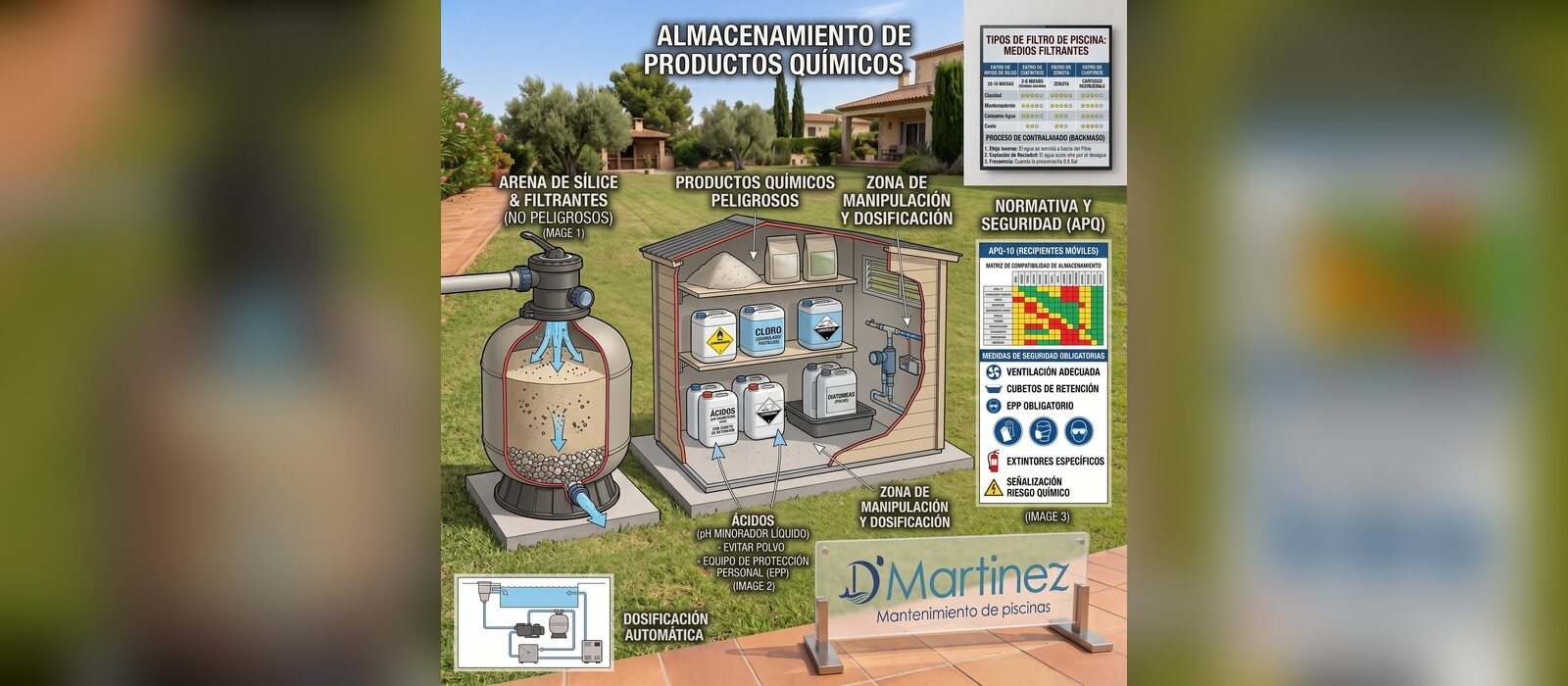
It's easy to think of chlorine or acid as "pool products" and let your guard down with them the way you would with any other DIY item. Legally, they're not: they're classified as hazardous substances or preparations, and their labelling, packaging and storage are governed by specific regulations.
The rule with no exceptions: never mix
The rule with no exceptions: never mix
This is, by far, the single most important recommendation. Mixing chlorine with an acid product can generate chlorine gas, which is toxic by inhalation, the same principle behind never mixing bleach with ammonia at home. In pool maintenance, this can happen in less obvious ways than you'd think:
- Reusing an "empty" container: residue stuck to the walls of a supposedly empty drum can react with the new product poured into it.
- Sharing a dosing container between different products: using the same container or doser for two different products in succession, without cleaning it thoroughly, is a real cause of accidents.
Good day-to-day practices
- Always buy products correctly packaged and labelled, never in bulk without their original container.
- Never remove the product's label, and read it before every use, not just the first time.
- Use appropriate protection (gloves, and goggles where needed) when handling them.
- Don't eat, drink or smoke in the area where they're stored.
- Keep containers properly closed between uses.
The safety data sheet (SDS)
This is a document that must accompany any professional chemical product, with detailed information: hazard identification, first aid, what to do in case of an accidental spill, and how to handle and store it correctly. It should always be kept accessible, near where the products are stored, not filed away in a drawer nobody checks during a real emergency.
What regulations require for communities and hotels
For pools for public or collective use, the room where chemical products are stored must be a room used exclusively for that purpose, separate from the room where water treatment takes place, a corner shared with the electrical panel or the general cleaning supplies store doesn't count. This is a point that, along with the rest of the documentation we cover in our guide on RD 742/2013 regulations, is worth having sorted before an inspection arrives.
At home, with children or pets
Beyond what the law requires for collective facilities, common sense should rule in any private home: pool products should be kept out of the reach of children and pets, in a ventilated location, away from heat sources and from other products they could react with, never next to household cleaning products without first checking their compatibility.
If there's an accident or poisoning
In case of an accident or poisoning from a chemical product, the first step is to contact a doctor. Keep these two numbers somewhere you can find them quickly, you don't need to memorise them, just know they exist:
91 562 04 20, National Institute of Toxicology, 24 hours a day.
If you need to go to a medical centre, don't forget to bring the product's label.
Frequently asked questions
Can chlorine be mixed with acid to save time?
Never. It can generate chlorine gas, which is toxic by inhalation. Each product is handled and stored separately.
Can an empty chlorine container be reused for another product?
No, residue left in it can react with the new product. Each product should stay in its original container.
What do regulations require for the storage room in communities?
It must be a room used exclusively for that purpose, separate from the water treatment room.