
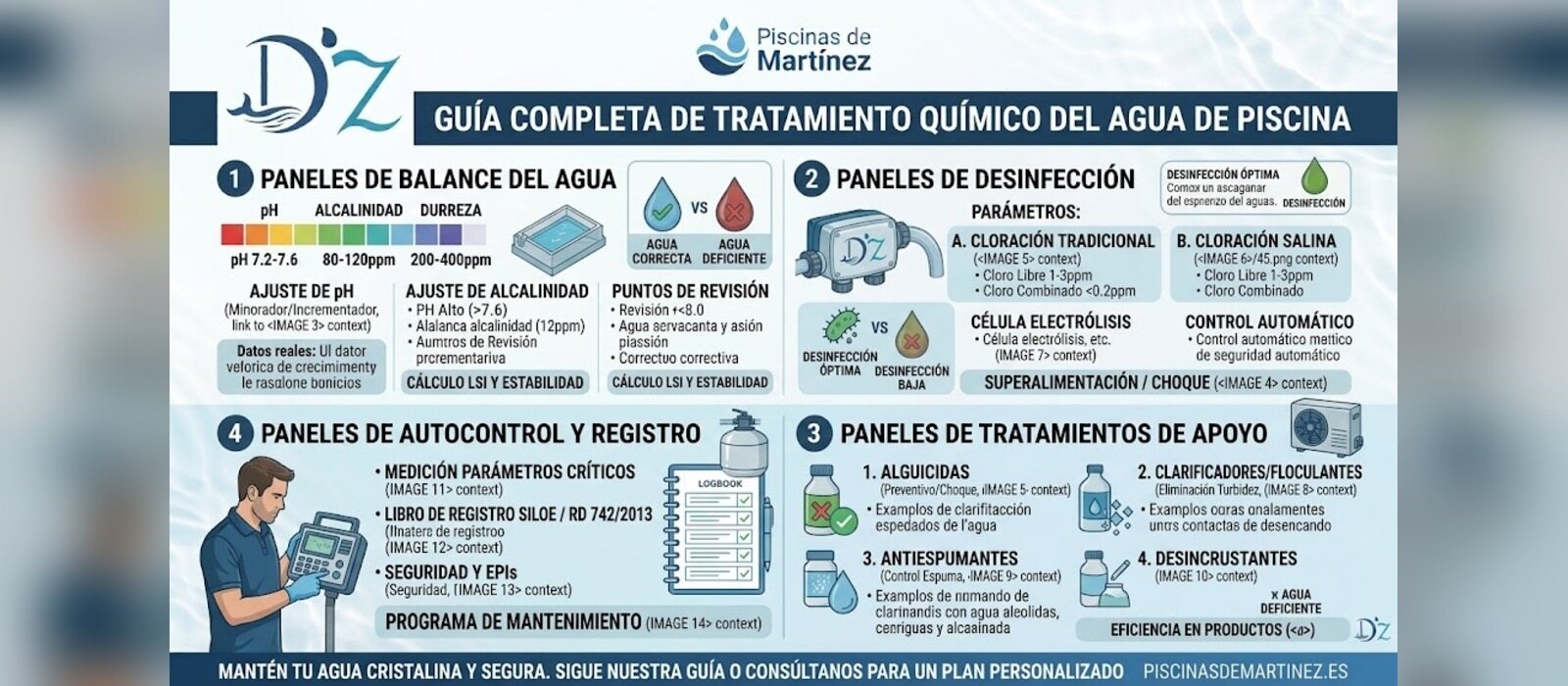
Pool water is never "still": wind, rain, sun and, above all, bathers gradually contaminate it. That's why it needs two types of treatment working together: a physical one (filtration) and a chemical one, which is what this guide is about.
Why is chemical treatment necessary?
Anyone who swims introduces sweat, skin flakes, creams and, to a lesser extent, urine into the water. All of that, together with what the air and surroundings bring in, can turn an untreated pool into a breeding ground for bacteria, fungi and viruses. Properly treated water has to guarantee four things: no microorganisms capable of making anyone ill, no toxic substances, no bad smell or taste, and a clean, clear appearance.
The 4 stages of chemical treatment
- pH regulation: the foundation for everything else; if the pH is out of range, every other product loses effectiveness.
- Disinfection: usually with chlorine, though bromine, active oxygen, ozone and UV systems also exist.
- Algae prevention: with a maintenance algicide, so you're not relying on chlorine alone.
- Flocculation: groups the finest suspended particles together so the filter can trap them.
The water's full journey
Water leaves the pool through the skimmer, passes through the pump and filter that trap dirt, gets its pH adjustment and chlorine dose, and returns to the pool already treated, a continuous cycle, not a one-off treatment.
Chlorine disinfection: the types available
Chlorine is still the most widely used disinfectant thanks to its good price and effectiveness as an oxidizer. It comes in two forms:
| Type | Examples | Form |
|---|---|---|
| Inorganic chlorines (unstabilized) | Chlorine gas, sodium hypochlorite, calcium hypochlorite | Gas, liquid or solid |
| Organic chlorines (stabilized) | Trichloroisocyanuric acid (trichlor), sodium dichloroisocyanurate (dichlor) | Solid (granules or tablets) |
An important nuance that causes confusion: a product's "active ingredient" (the percentage of disinfectant it contains) is not the same as its "available chlorine" (the actual disinfecting power compared to pure chlorine gas). For example, a dichlor product with 99% active ingredient may have only 55% actual available chlorine.
Free, combined and total chlorine: why a badly treated pool smells so much
Here's the key fact almost nobody knows: the "pool smell" isn't caused by chlorine, it's caused by a lack of chlorine. Specifically:
- Free chlorine: the chlorine that's actually available to disinfect.
- Combined chlorine (chloramines): forms when free chlorine reacts with the ammonia and nitrogen compounds that bathers bring in (sweat, urine, creams). This is what irritates eyes, dries out skin and causes that typical strong smell, and it barely disinfects at all.
- Total chlorine: the sum of the two above.
When combined chlorine builds up, the solution isn't to "add less chlorine", it's the opposite: a shock chlorination (also called a "break point"), which involves adding a large dose of chlorine all at once that's able to chemically break down the chloramines and release them as harmless nitrogen gas.
Water balance: much more than just pH
"Balanced" water depends on five factors that are studied together, not separately:
| Factor | What it indicates |
|---|---|
| pH | Recommended between 7.2 and 7.6 (regulations allow 7.2 to 8.0): bather comfort, protection of the installation and maximum chlorine effectiveness. |
| Total alkalinity | Acts as a pH "buffer"; with good alkalinity, pH doesn't swing sharply. |
| Calcium hardness | Amount of dissolved calcium; too low corrodes fittings, too high causes scale buildup. |
| Total dissolved solids (TDS) | Everything that would remain if the water evaporated; rises over time and is reduced by draining some water or backwashing the filter more. |
| Langelier Index | Combines the four factors above plus temperature to determine whether the water tends to be corrosive or scale-forming. |
When the Langelier Index comes out below zero, the water tends to be aggressive toward pipes, ladders and other metal fittings. Above zero, it tends to form limescale. The ideal is to stay close to zero (± 0.5 is considered a good margin).