
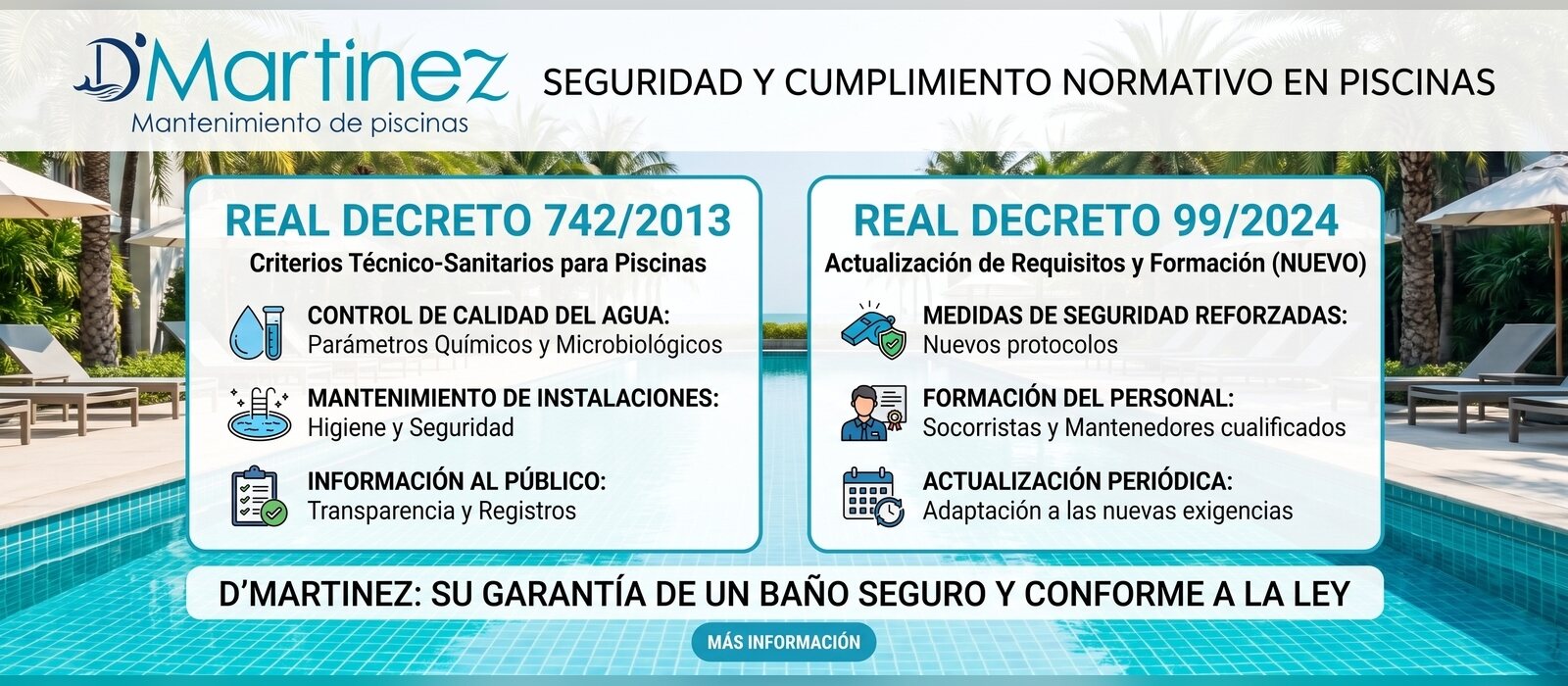
Real Decreto 742/2013 is the national regulation governing water quality in pools for public or collective use, residential communities, hotels, campsites. It's not optional paperwork: it sets out exactly what controls must be carried out, how often, and what documentation must be available to show if the health authority asks for it.
The three checks, and where they’re logged
Initial control
Before opening, only if the water doesn't come from the public supply or the pool had been closed for over 2 weeks.
Routine control
Daily, pH, residual disinfectant, turbidity, transparency and temperature.
Periodic control
Monthly, and more thorough, verifies compliance with every parameter in the regulation.
In the Community of Madrid, these checks and their log are required by Decreto 99/2024 for residential communities of more than 30 homes, with the routine check twice a day (art. 16). Communities of up to 30 homes are exempt unless the health authority asks; the water must still meet the same values.
The three types of control the regulation requires
RD 742/2013 sets out three distinct controls, each with its own purpose and frequency:
- Initial control: carried out before the season opening, but only mandatory for pools whose make-up water doesn't come from the public supply network, or after the pool has been closed for more than two weeks. It checks microbiological parameters and, in heated indoor pools, also air quality.
- Routine control: a daily control designed to check that water treatment is genuinely working, pH, residual disinfectant, turbidity, transparency and temperature.
- Periodic control: a more thorough monthly control that verifies compliance with all the parameters set by the regulation.
The Sanitary Control Record Book
This is the document where every control carried out is recorded: results, incidents detected and the corrective measures applied in each case. It's not a decorative formality, it's the first thing a health inspector asks for, and its absence, or being poorly filled in, is grounds for a penalty on its own, even if the water is in perfect condition on the day of the inspection.
Where samples are taken
The regulation doesn't leave this to free judgement, it requires, at minimum, two representative sampling points:
- One in the circuit, at the pool's inlet (or at the outlet of the treatment, before that inlet).
- One in the pool itself, in the area furthest from the water inlet point, where treatment has the least effect and any problem shows up soonest.
What's worth having ready before the season opening
Beyond the lab controls, there's documentation worth having organised well in advance, not at the last minute:
- The updated Record Book, with the history from the previous season.
- The Safety Data Sheets (SDS) for every chemical product used in maintenance.
- The current maintenance service contract.
- If the pool requires a lifeguard, documentation proving their qualification, mandatory for pools of collective use, not optional.
All this documentation, together with the professional certificate that will already be mandatory for technical staff from 2027, is what a property manager needs on hand to respond confidently to any inspection. You can see the detail of that other requirement in our guide on the mandatory 2027 professional certificate.
Frequently asked questions
What controls does RD 742/2013 require of a community with a pool?
Initial control (before opening, where applicable), routine control (daily) and periodic control (monthly).
What is the Sanitary Control Record Book?
The document where every control carried out is recorded. The health authority can request it at any inspection.
Who is liable if the community doesn't comply with the regulations?
The residents' association, as the owner of the facility, not just the contracted maintenance company.