
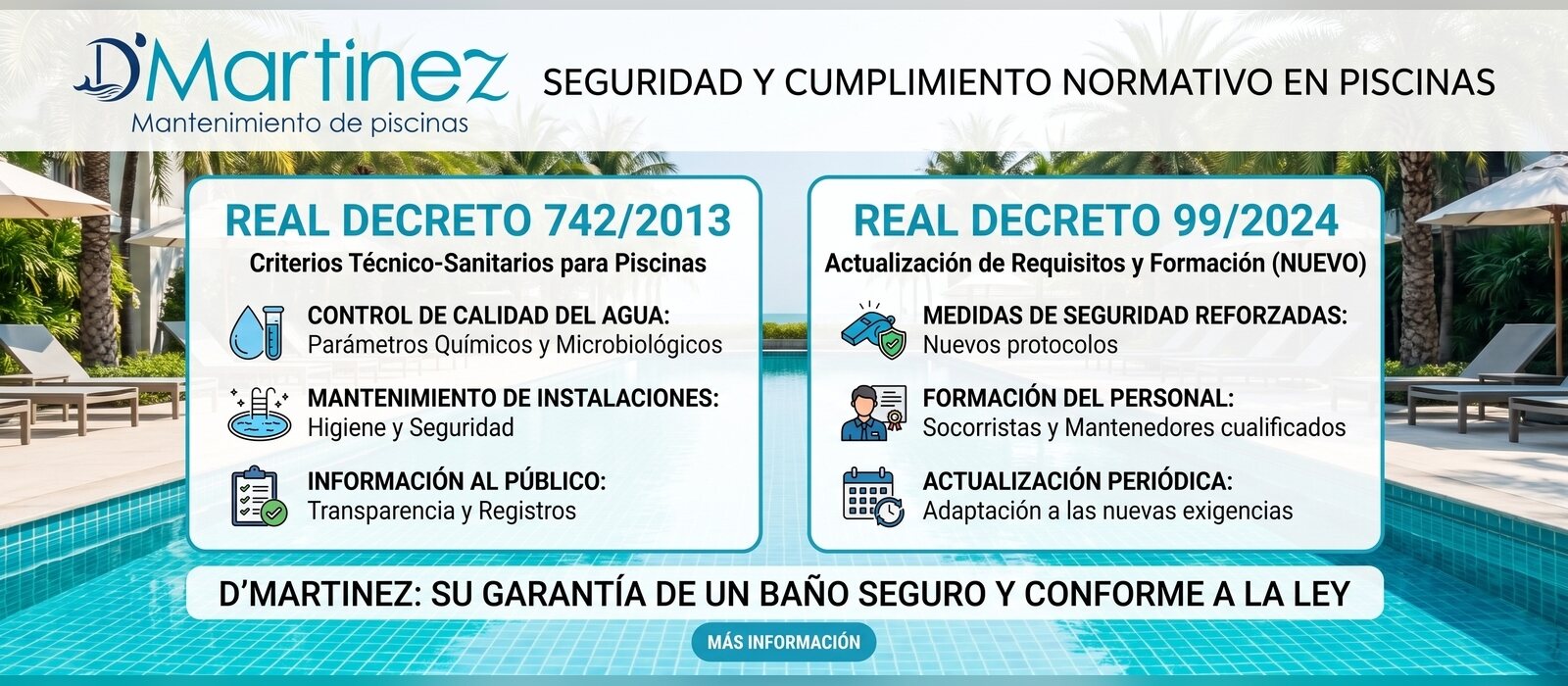
On 30 October 2024, the Governing Council of the Comunidad de Madrid approved Decreto 99/2024, which replaces the old Decreto 80/1998 and develops, at regional level, the criteria of RD 742/2013 that we already covered at national level. It came into force ahead of the summer season, and applies both to private community pools (Type 3A) and to hotel and public-use pools.
What has to be on display
Measuring turbidity
With kits meeting UNE-EN ISO 7027-1 (infrared), always kept at the facility.
Seasonal water tests
The initial one in the fortnight before opening, then at least one a month.
Health-care staff
Mandatory in pools with more than 500 m² of water surface.
Children under 12
Cannot access the pool or the surrounding deck without being accompanied by an adult.
The most relevant changes brought by the new decree
- Measuring turbidity: the decree accepts kits meeting UNE-EN ISO 7027-1 (infrared measurement), which must be kept at the facility at all times (art. 17). It applies to pools required to carry out routine checks, including communities of more than 30 homes.
- Water tests: an initial check in the fortnight before opening, with results available before opening (arts. 12 and 16), and a periodic check at least once a month (Annex III). Over a three-month summer season that comes to about four tests per pool.
- Health-care staff at large pools: facilities whose water surface exceeds 500 m² must have a nurse or doctor on hand during opening hours.
- Children under 12: cannot access the pool, deck or beach area without being accompanied by an adult.
- Emptying the water every year is no longer mandatory: the water in the pool can be kept over the closed season, as long as its quality is guaranteed when reopening, a new provision aimed at saving water.
Values the water must meet
The decree keeps the values in Annex I of RD 742/2013. These are what routine checks and inspections test for:
| Parameter | Required value | Pool closed if… |
|---|---|---|
| pH | 7.2-8.0 | below 6.0 or above 9.0 |
| Free chlorine | 0.5-2.0 mg/l | no chlorine or above 5 mg/l |
| Combined chlorine | max. 0.6 mg/l | above 3 mg/l |
| Cyanuric acid | max. 75 mg/l | above 150 mg/l |
| Total bromine (if bromine is used) | 2-5 mg/l | above 10 mg/l |
| Turbidity | max. 5 NTU | above 20 NTU |
| Transparency | bottom drain visible | bottom drain cannot be made out |
| Temperature (heated pools) | 24-30 °C (≤ 36 °C in hot tubs) | above 40 °C |
| Redox | 250-900 mV | at the health authority's discretion |
In our maintenance we work tighter than the legal minimum: pH between 7.2 and 7.6 and cyanuric acid between 30 and 50 ppm, where chlorine performs best. You'll find every range in the water parameters guide.
Information the owner must make visible
The decree requires making available to users, in a visible and accessible place, the results of the latest checks, any non-compliance and its corrective measures, information on the chemical products used, whether or not there is a lifeguard, the usage rules, and the availability of complaint forms (art. 28). Also information on preventing drowning and injuries and, at outdoor pools, on sun protection, plus the addresses and phone numbers of the nearest health centres and emergency services.
Communities of up to 30 homes
The decree exempts owners' communities of up to 30 homes from several obligations: routine checks and their log (art. 16.3), the self-monitoring protocol (art. 18.4) and the requirement to have a lifeguard (art. 24.4), unless the health authority requires the checks. The water must still meet the same quality values. We explain it in the guide to the pool log book.
If you manage a community in Madrid, these regulations add to the documentation we already covered in our guide to RD 742/2013, together, they form the complete framework you should have sorted before each season.