
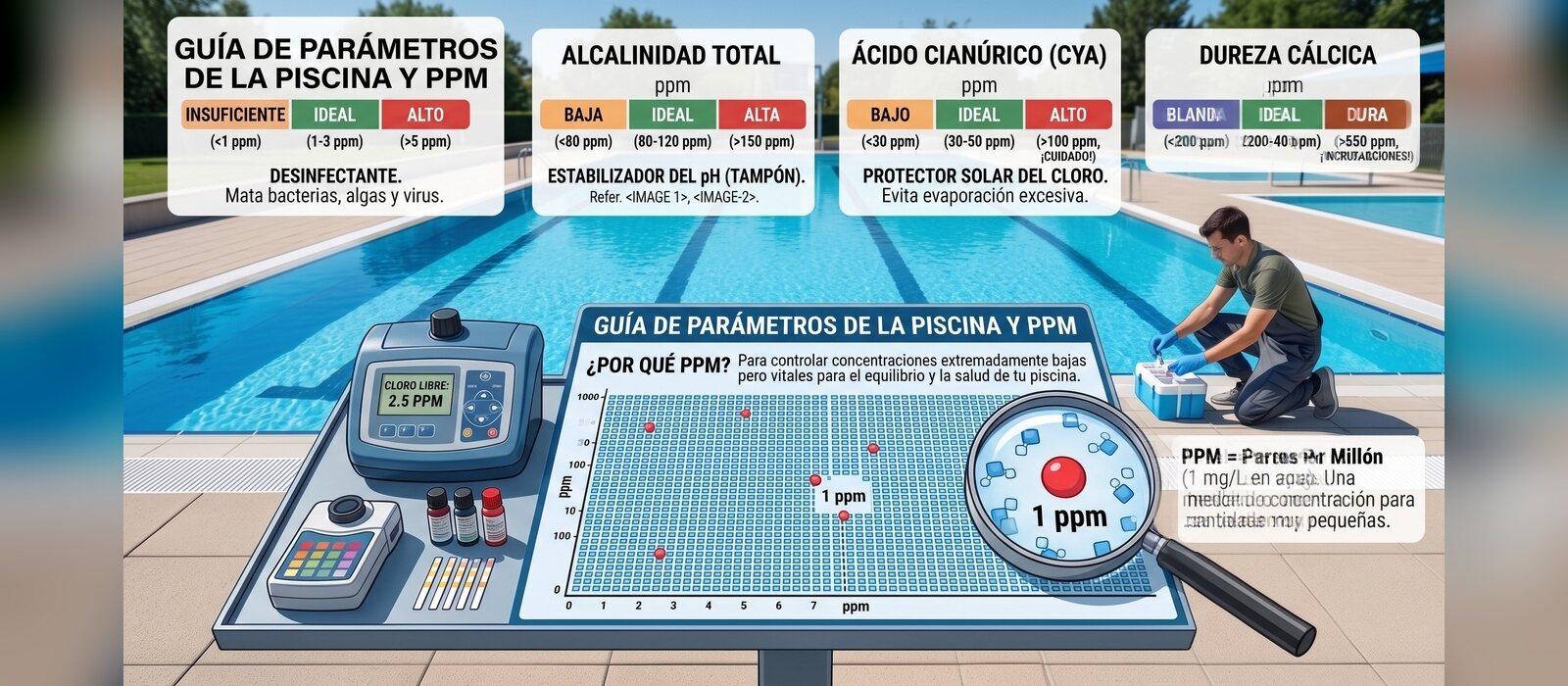
Pool water isn't maintained by "eyeballing" it. Behind clear water that feels pleasant to the touch is a balance of several chemical parameters that, when properly controlled, make swimming safe, comfortable and inexpensive to maintain in the long run.
pH
The parameter that most affects the others, with unbalanced pH, chlorine barely disinfects. Decreto 99/2024 legally allows up to 8.0, but above 7.6 chlorine already starts losing effectiveness.
Free chlorine
The disinfectant that eliminates bacteria and microorganisms, without it, the water is no longer safe for swimming.
Combined chlorine
This is chlorine that's already "spent," combined with contaminants, the higher it is, the more it smells of chlorine and the less it actually disinfects.
Total alkalinity
Acts as a pH "buffer," preventing it from rising or falling sharply from one day to the next.
Cyanuric acid
Protects chlorine from breaking down in the sun, without it, chlorine gets used up within hours outdoors. The legal limit is 75 ppm; above that, chlorine stops working properly even if the amount is correct.
The key parameters, at a glance
pH
IdealFree chlorine
IdealAlkalinity
IdealCalcium hardness
IdealSample readings from a well-maintained pool, each needle rests in its ideal green zone. See the table below for each parameter's exact range.
| Parameter | Recommended | Legal limit RD 742/2013 · Madrid region | What it's for |
|---|---|---|---|
| pH | 7.2-7.6 | 7.2-8.0 | Determines whether the water is acidic or basic; affects chlorine's effectiveness and comfort for skin and eyes. |
| Free chlorine | 0.5-2.0 ppm | 0.5-2.0 mg/l | The disinfectant that removes bacteria and microorganisms from the water. |
| Combined chlorine | max. 0.6 ppm | max. 0.6 mg/l | Chloramines that are already "spent", the higher it is, the worse it smells and the less it disinfects. |
| Total alkalinity | 80-150 ppm | Not regulated | Acts as a pH "buffer," preventing it from rising or falling sharply. |
| Calcium hardness | 150-300 ppm | Not regulated | Regulates dissolved calcium; too low corrodes fittings, too high causes scale buildup. |
| Cyanuric acid (stabilizer) | 30-50 ppm | max. 75 mg/l | Protects chlorine from breaking down in the sun, so it lasts longer in the water. |
| Salt (pools with a chlorinator) | 3-6 g/l | Not regulated | Raw material that the salt chlorinator converts into chlorine through electrolysis. |
| Temperature | 24-28 °C | 24-30 °C heated pools | Swimming comfort; the higher the temperature, the faster chlorine is used up. |
| Turbidity | Crystal-clear water, bottom clearly visible | max. 5 NTU | Measures how cloudy the water is; in pools subject to checks, Decreto 99/2024 accepts measuring it with kits meeting UNE-EN ISO 7027-1. |
| Redox (ORP) | Above 650 mV | 250-900 mV (only if the disinfectant isn't chlorine or bromine) | Shows the water's real disinfecting power; measured by the probes of automatic dosing systems. |