
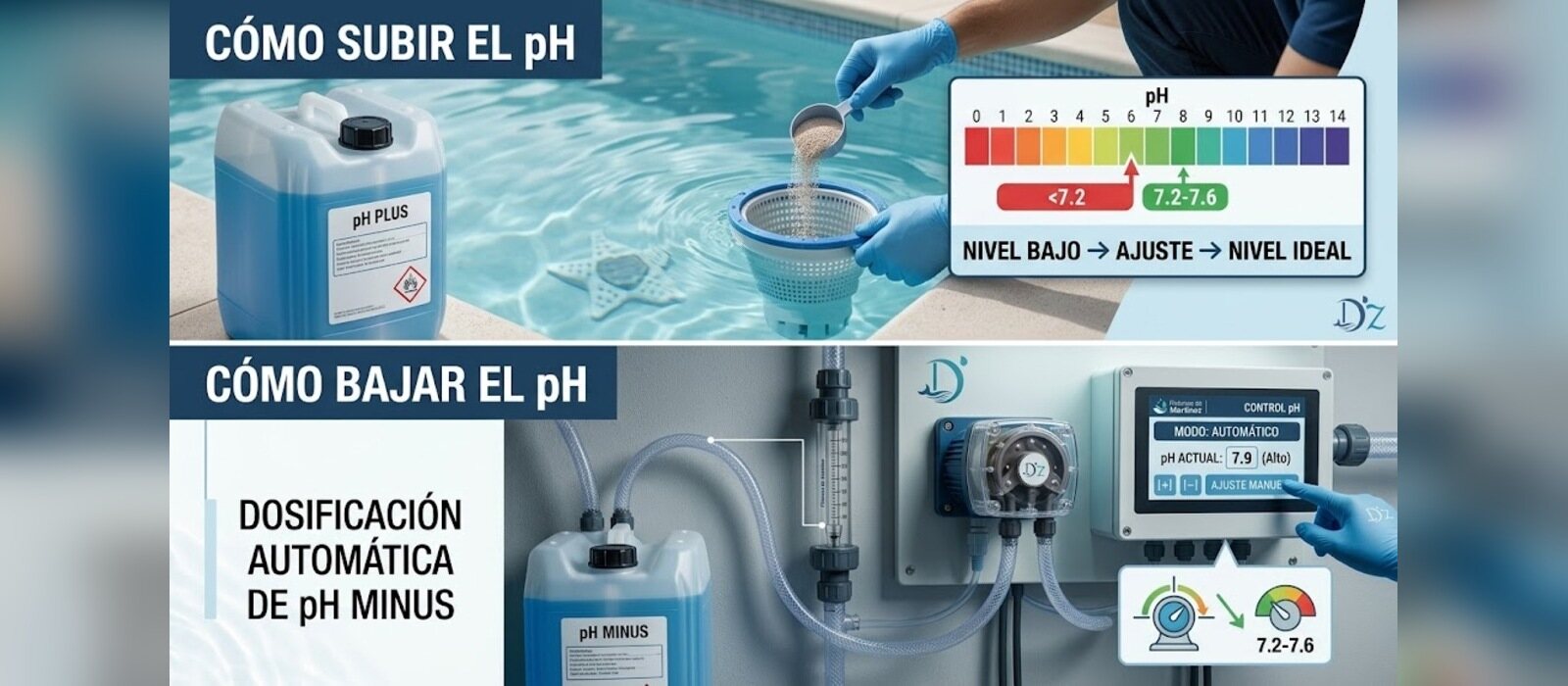
pH measures whether water is acidic or basic, on a scale of 0 to 14. For a pool, the ideal range is 7.2-7.6. It looks like a narrow margin, but it's what makes chlorine work as it should and keeps the water from damaging either the equipment or your skin. You can see the rest of the parameters in our complete water parameters guide.
Water pH
Below this range it irritates eyes and skin and corrodes equipment. Above it, chlorine barely disinfects and encourages scale buildup. Decreto 99/2024 legally allows up to 8.0, but 7.2-7.6 is the range where chlorine performs best.
Why pH is the parameter that matters most
Even perfectly dosed chlorine barely disinfects if the pH is off. That's why it's so common to feel like "I keep adding chlorine and it does nothing": it's usually not a chlorine problem at all, the pH just isn't letting that chlorine do its job. Correcting the pH before anything else is, almost always, the first step to fixing cloudy or bad-smelling water.
Move the pH and see how much chlorine is really working
Of the chlorine you add to the water, only part of it converts into hypochlorous acid, the form that actually disinfects. The rest just sits there doing nothing, waiting for the pH to drop.
Calculated using the standard chemical model for the hypochlorous acid/hypochlorite equilibrium (pKa ≈ 7.5), the same principle behind why "adding more chlorine" doesn't always fix anything if the pH is still off.
How to tell if it's too high or too low
With test strips, a photometer or a liquid drop kit you can measure it in under a minute. Some rough warning signs, though it's always worth measuring to confirm:
- Low pH (acidic water): irritated eyes and skin, water that feels "harsh", and over time corrosion of ladders, fittings and other metal fixtures.
- High pH (basic water): cloudy or milky-looking water, a strong chlorine smell even when the chlorine level is correct, and scale buildup on the walls and shell as the weeks go by.
How to raise the pH (if it's low)
This is corrected with an alkalinity increaser (usually sodium carbonate, known as pH+). The correct way to apply it:
- With the filtration pump running, dissolve the product in a bucket of water and spread it around the pool, never pour it directly, concentrated, into a single spot.
- Add it gradually: it's better to correct a little at a time and re-test than to overshoot and have to correct in the opposite direction.
- Wait at least a couple of hours with the filtration running before measuring again.
How to lower the pH (if it's high)
This is corrected with an acid reducer (dry acid/granular pH-, or liquid acid). The procedure is essentially the same, with one important safety precaution:
- Always add the product to the water, never the water to the product, this is the basic safety rule when handling any pool acid.
- Dissolve and spread it around the pool with the pump running, just as with pH+, and correct it gradually.
- Wear gloves and avoid breathing near the concentrated product, especially with liquid acid.
Frequently asked questions
Why does my pool use so much chlorine and still have problems?
It's almost always the pH. When the pH is off, chlorine loses much of its disinfecting power, so you end up using more product to get worse results.
Can I swim with the pH out of range?
It's not advisable. A low pH irritates the eyes and skin, and a high pH greatly reduces chlorine's effectiveness, which compromises water disinfection.
How often should I measure pH?
During the swimming season, it's best to measure it 2-3 times a week, and always after heavy use or heavy rain.