
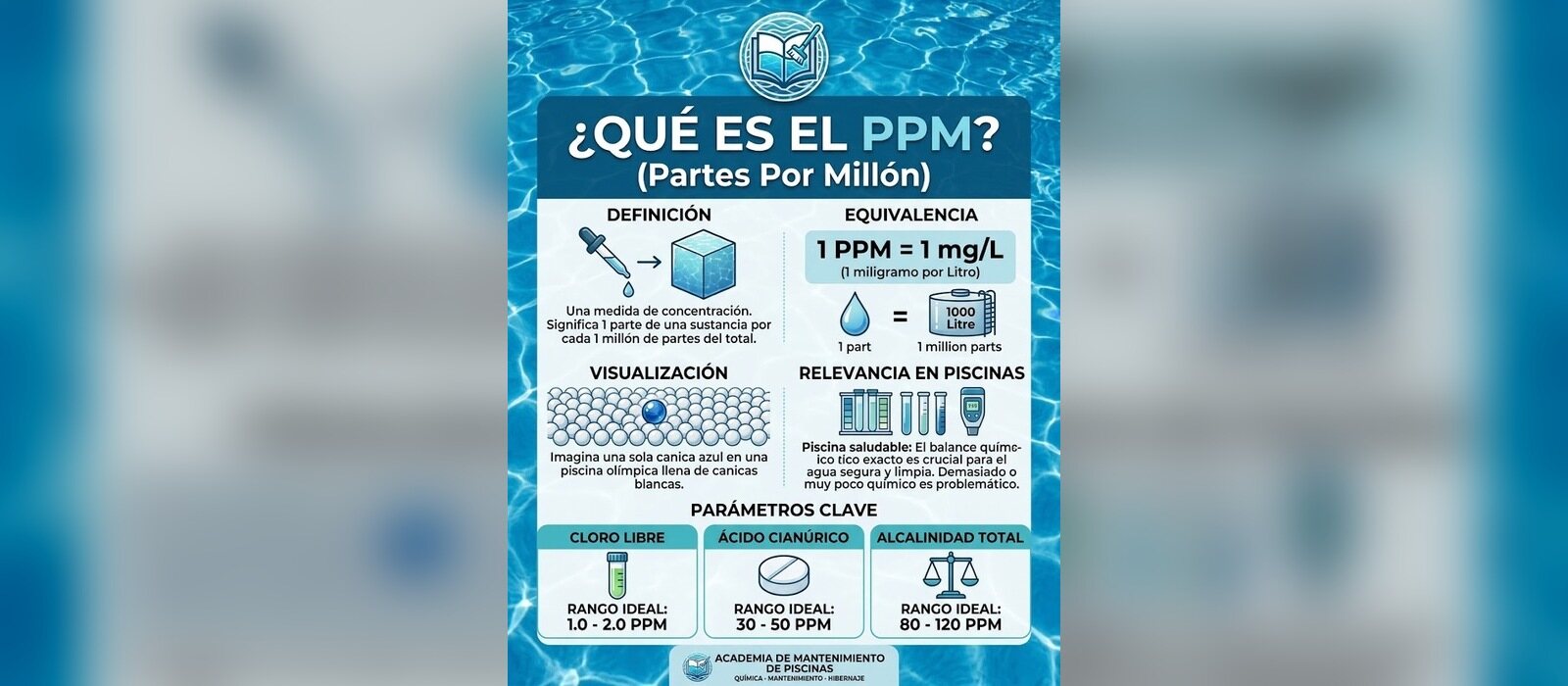
PPM stands for "parts per million." It's a way of expressing very small concentrations: how many parts of a substance there are for every million parts of water. Such an abstract figure is much easier to understand with a real pool example.
1 ppm, to scale
A simple example
Saying a pool has "2 ppm of free chlorine" means there are 2 milligrams of dissolved chlorine per liter of water. It doesn't matter whether the pool holds 10,000 liters or 80,000, the concentration (2 ppm) is the same in both, even though the total amount of dissolved chlorine is very different. That's precisely the usefulness of PPM: it lets you talk about "how much chlorine there is" without having to specify the pool's size every time.
Why the industry uses PPM instead of liters or grams directly
Because the amounts of chlorine, pH or alkalinity dissolved in water are very small compared with the total volume. Talking about "0.000002 kg of chlorine per liter" would be impractical, expressing it as "2 ppm" is much easier to work with, and it's the standard used by product manufacturers, test strips and photometers alike, so any test you buy speaks the same language.
PPM is not the same as the product's %
This is where it's easy to get confused: the percentage that appears on the chlorine container's label measures the concentration of the product you buy, before you put it in the water. PPM, on the other hand, measures the concentration already dissolved in the pool, after applying it. They are two measurements of two different moments of the same process, the percentage tells you how strong what you're buying is, the PPM tells you how the water turns out once it's been applied.
Frequently asked questions
Is PPM the same as percentage?
No. Percentage measures the concentration of chlorine in the product you buy; PPM measures the concentration of chlorine already dissolved in the pool water.
Why aren't liters or grams used directly?
Because PPM lets you compare concentration without depending on the size of the pool, 2 ppm means the same thing in any pool, whatever its volume.
What chlorine PPM should my pool have?
The target range in the Comunidad de Madrid is 0.5 to 2.0 ppm of free chlorine.