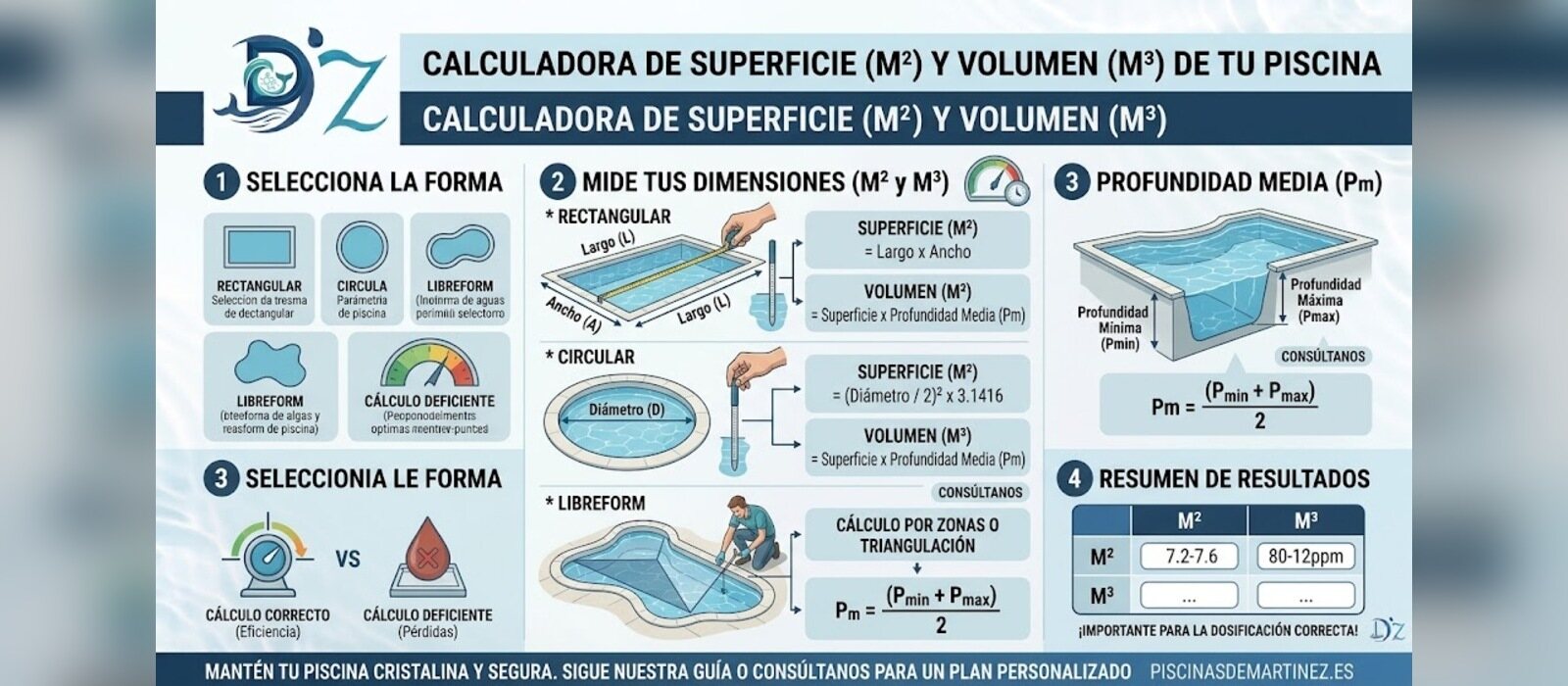
Find out in seconds the water volume and surface area of your rectangular, oval or circular pool. We also explain how to calculate it by hand and what each figure is used for.
Measure the maximum length and width, as if you were wrapping the pool in a rectangle. The calculation applies an approximate correction for free-form shapes.
If your pool has a flat bottom, enter the same value in both fields.
Fill in all measurements with values greater than zero.
Surface area0 m²
Water volume0 m³
Equivalent to0 litres
Estimated salt (first charge)0 kg
Estimated capacity0 bathers
Estimated calculation. For pools with an irregularly sloped bottom or mixed shapes, we recommend confirming it during the technical visit.
We were unable to show the 3D view in this browser (this may be due to an extension that blocks access to 3D graphics, or the browser not supporting it). Your pool's data above is still correct.
This is how full your pool ends up, drag to rotate it.
Is your filter right for your pump?
Calculate the actual filtration rate of your setup, the figure that determines whether the filter is too small for the pump's flow rate.
Fill in the filter diameter and the pump flow rate, both greater than zero.
0 m³/h/m²
Correct
Regulations require the filtration rate of a sand filter, in pools for collective use, to be between 40 and 50 m³/h/m². Below 30 m³/h/m² is considered the optimal range for good filtration results.
Escucha esta guíaIdeal si tienes las manos ocupadas junto a la piscina
Knowing how many m³ your pool has isn't just curiosity: it's the figure that almost everything else depends on, from the amount of chlorine or salt you need to the size of the filtration unit or the cost of filling it. Here are the formulas explained, in case you'd rather calculate it yourself or simply understand where the numbers come from.
How to calculate volume (m³) by shape
Rectangular pool: multiply length × width × average depth. If the pool has a shallower area and a deeper area (the usual case), first calculate the average depth by adding the minimum and maximum and dividing by 2.
Shape
Volume formula
Rectangular
Length × Width × Average depth
Oval
π × (Length ÷ 2) × (Width ÷ 2) × Average depth
Circular
π × (Diameter ÷ 2)² × Average depth
Irregular / kidney
Max length × Max width × 0.75 × Average depth (approximate)
A quick example: a rectangular pool of 8 × 4 m, with 1.10 m in the shallower area and 1.90 m in the deeper area (average depth of 1.50 m), has 8 × 4 × 1.50 = 48 m³, that is, 48,000 litres of water.
1 m³ of water is exactly equal to 1,000 litres. That is the conversion the calculator above uses to give you the result in litres.
Why it's worth knowing how to calculate your pool's volume
Exact chemical dosing
Chlorine, pH, algaecide or salt are dosed based on the litres of water. Without the correct volume, you're always guessing.
Choosing the right salt chlorinator
Each salt chlorination unit is designed for a specific m³ range. One that is poorly sized either won't generate enough chlorine or will wear out ahead of time.
Sizing the pump and filtration unit
The pump's flow rate and the filter's size must be calculated to turn over the entire water volume within the recommended time.
Calculating the fill cost
With exact litres you can realistically estimate the water cost of a full fill or a top-up after winter.
More efficient heating
Choosing the right heat pump or heater also depends on the volume of water that needs heating.
More accurate quotes
When you ask for a maintenance or product quote, giving the exact volume speeds up the response considerably.
And what is the m² (surface area) used for?
Volume isn't the only useful figure: the water surface area (m²) is calculated the same way as the volume but without multiplying by depth, and it's used for other, different things:
Bather capacity: in community pools, hotels or pools for collective use, health regulations limit how many people can bathe at once based on the m² of water surface. A very common rule of thumb is 1 bather per 2 m² of water surface, and in the Community of Madrid it is exactly the legal criterion: 2 m² of water surface per bather, except in paddling pools (Decreto 99/2024, art. 22).
Covers and thermal blankets: these are ordered to measure based on the pool's exact m².
Lining renovation: calculating how much mosaic tile, liner or paint is needed for a renovation is also based on the pool shell's surface area (in this case the walls must also be added, not just the bottom).
Solar heating: the size of a solar cover or solar thermal panels is calculated as a percentage of the pool's m².
If your pool is for collective use (residents' community, hotel, sports centre), the exact legal capacity depends on your region's health decree. We check and document this as part of the maintenance service for collective pools.
Would you rather we measure and calculate it for you?
On the first visit we measure your pool, calculate the exact volume and tell you what equipment you need.
For mixed or irregular shapes, a good approximation is to divide the pool into 2 or 3 simple shapes (for example, a rectangle plus a semicircle), calculate each one separately and add the results together. If you'd rather not complicate things, we can measure it for you during the visit.
Because most pools have a shallower area (the beach entry) and a deeper area. Using the average depth between the two gives a much more realistic volume than using only the maximum depth.
It's an approximate reference. For a new pool we use ~4 kg of salt per m³ (up to the usual ~4,000 ppm). If you already have a salt chlorinator, tick the "I already have a salt chlorinator" box and enter your level as measured with a salt meter: that way we calculate only the salt needed to reach the target, not a full charge from scratch.
Yes, it's very useful information that speeds up the quote. Even so, we always confirm the measurements during the visit before finalising any proposal.
We use our own and third-party cookies for the website to function, to measure audience and to improve your experience. You can accept them all, reject non-essential ones, or set your preferences. More information in our Cookie Policy.
Cookie settings
Choose which types of cookies you accept. You can change this setting at any time from the "Cookies" link in the footer.
Necessary
Essential for the website to function properly (menu, form, security). They cannot be disabled.
Analytics
They help us understand how the website is used (most visited pages, time spent) so we can improve it.
Marketing
Used to show you relevant information on WhatsApp or social media after visiting the website.