
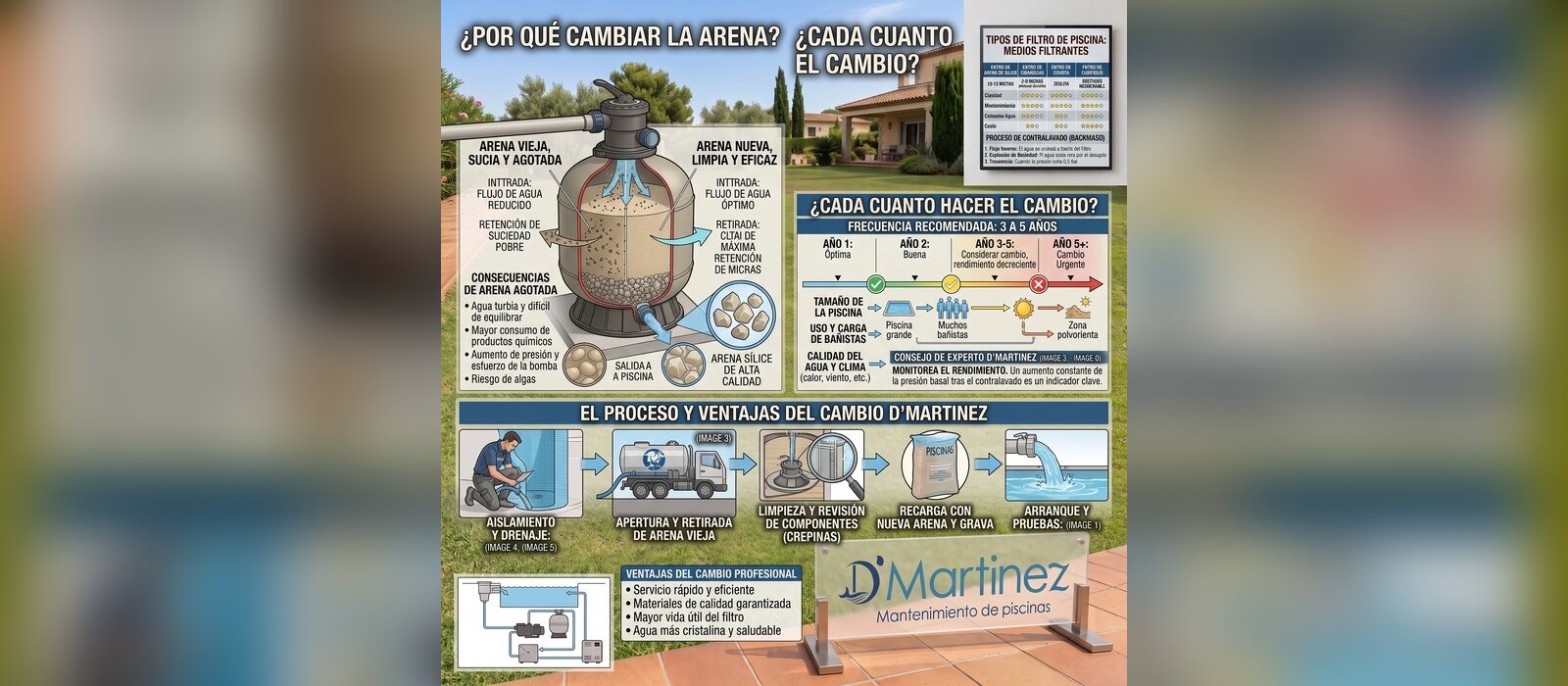
The sand filter is the heart of filtration: all the pool water passes through it over and over, and it's the sand that holds back the dirt. When that sand wears out, the rest of the maintenance (chlorine, pH, cleaning) works much worse, even if you do everything right.
Worn-out sand versus new sand
Why does filter sand wear out?
The filter's silica sand isn't "used up" like chlorine, but it does deteriorate with use: the grains wear down and become rounded, lose their capacity to trap fine particles, and over time compact together forming channels through which water passes without really being filtered. On top of that, over the years it accumulates grease, calcium and organic matter that not even backwashing can fully remove.
Signs it's time to change the sand
- The water isn't fully crystal-clear even though chlorine and pH are within their correct range.
- You need to backwash more and more often because the pressure gauge rises very quickly.
- Filter pressure is high even right after washing, a sign the sand is compacted.
- Fine sand comes out through the return jets into the pool, a sign the grains have degraded.
- You notice a damp or "earthy" smell in the filter when you open it.
- The useful lifespan has passed: as a rough guide, between 4 and 6 years for normal domestic use, somewhat less for very heavily used pools (communities, hotels).
What you gain with new sand
Pressure gauge reading: high
- Cloudy water, no real clarity
- Very frequent backwashing
- More chlorine used to compensate
- Higher risk of algae
Pressure gauge reading: optimal
- Truly crystal-clear water
- Longer intervals between washes
- Effective disinfection, less product used
- Fewer issues and emergency visits
| With worn-out sand | With new sand |
|---|---|
| Poor filtration, fine particles pass through | Effective retention, genuinely clear water |
| Frequent backwashing, more water used | Longer intervals between washes, less water wasted |
| The pump works harder to push water through the compacted sand | Less strain on the pump, some savings on electricity use |
| Chlorine is used up faster trying to compensate for poor filtration | Better use of chemical products |
| Higher risk of cloudy water or algae | Fewer issues and fewer emergency visits |
How we do it
Replacing the sand involves fully emptying the filter, removing the old sand, checking the condition of the laterals and internal manifold (a part just as important as the sand itself: if it's damaged, the new sand wears out sooner than normal), and refilling with silica sand calibrated to the correct grain size for your filter model. We finish with a start-up backwash before returning the pool to normal use.
Video summary: why filter sand wears out and what replacing it involves.
How long has your filter's sand gone without being changed?
If you can't remember, it's probably time to check it. We'll check it for you with no obligation.