
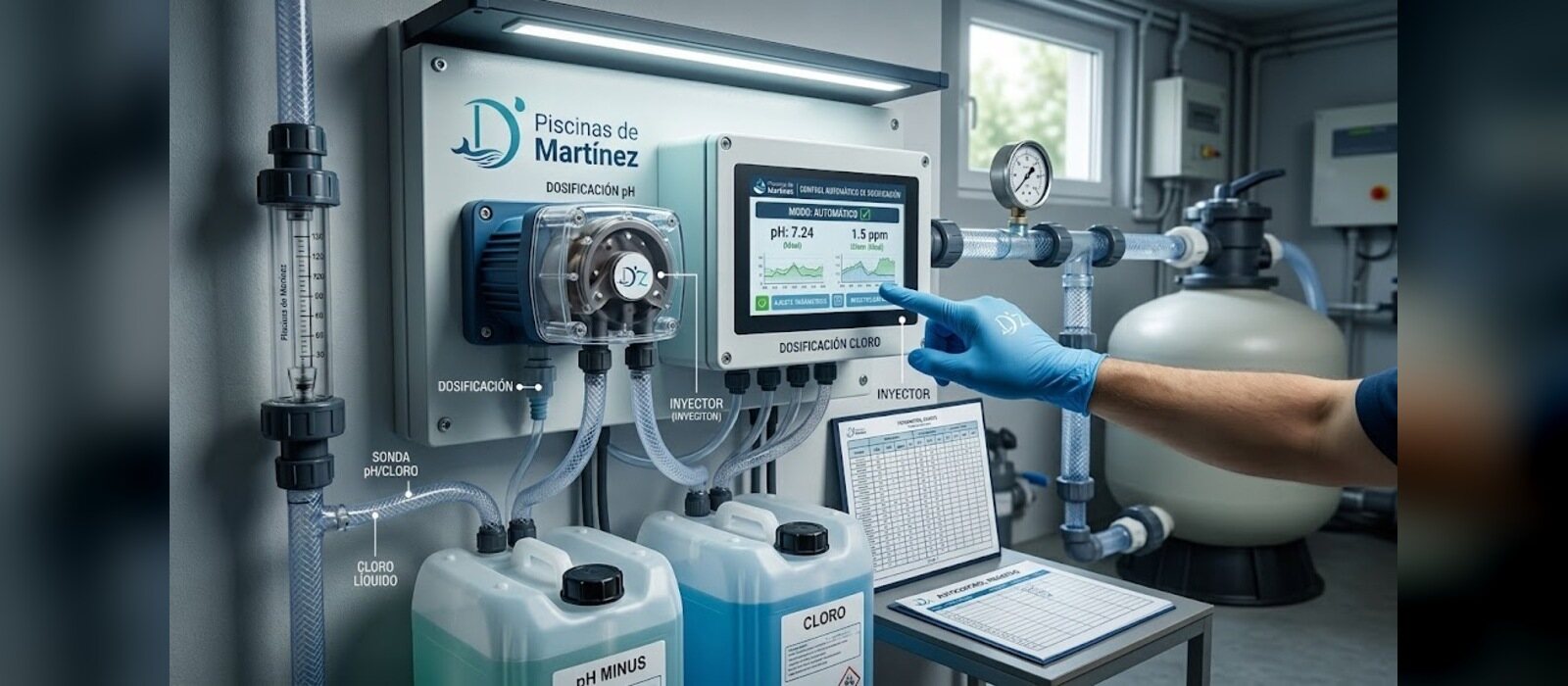
Adding chemical products "by eye", with a bucket and a rough measure, is an image very much associated with home pool maintenance. But as soon as bathers are present, regulations no longer allow it, and there's a good safety reason behind it.
Automatic dosing, drop by drop
What the regulations say
Chemical products may only be added to the pool water manually when carrying out a shock treatment, and always with no bathers present, who can only use the pool again once the physicochemical parameters are back within permitted values. With bathers present, the dosing of chemical products must be automatic or semi-automatic, with no exceptions.
What a dosing pump is
These are a type of special pump used to correctly dose a chemical substance into a water stream, a tank, or any system where the concentration of that substance (chlorine, polymers, sodium metabisulfite, pH regulators...) needs to stay constant over time.
The 2 most common types
Pulse-driven push
- Doses with the movement of a flexible diaphragm
- The usual choice for medium and high flow rates
Tube compression
- The product never touches any mechanical part
- Very common with especially corrosive products
- Diaphragm pumps: dose through the movement of a flexible diaphragm that pushes the liquid with each pulse.
- Peristaltic pumps: dose by progressively compressing a flexible tube, so the chemical product never touches any mechanical part, very common with especially corrosive products.
Both types need to be regulated and calibrated periodically, to make sure the amount of product they're actually delivering matches the amount programmed.
Which products they dose
Disinfectant (chlorine), pH regulators, flocculant and algaecide, any product whose concentration needs to stay within a constant range, without the peaks and troughs typical of occasional manual dosing.
How it relates to the rest of the system
Automatic dosing works together with water parameter measurement, the system doses based on the actual chlorine and pH readings, not on a fixed schedule, adjusting to the pool's real use at each moment of the day.