
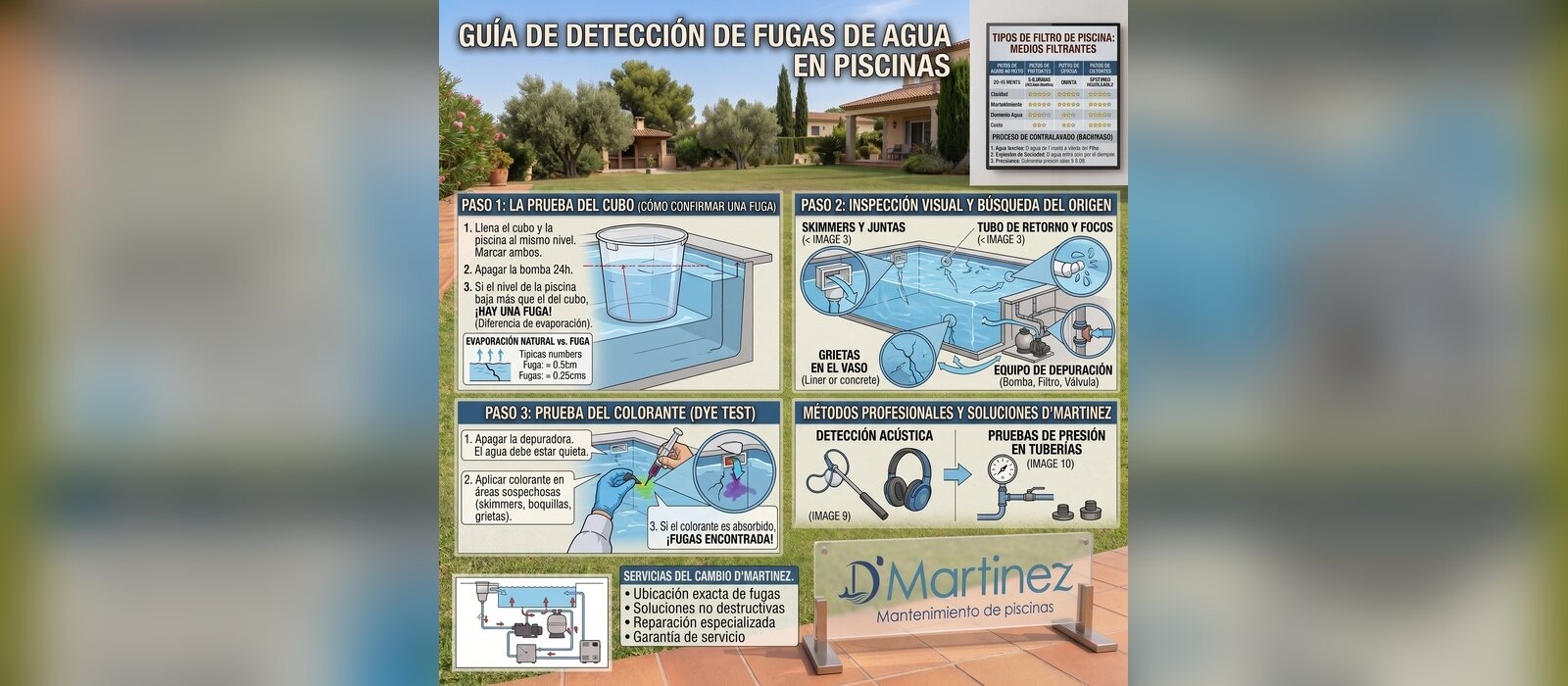
A drop in the water level doesn't always mean there's a problem. Heat, wind and normal pool use mean some water is lost to evaporation every day. Reasonable doubt appears when that drop is bigger than expected, or keeps happening, and that's when it's worth settling the question with certainty, not by guesswork.
Where leaks usually hide
The bucket test: telling a leak apart from evaporation
It's the most reliable method and, at the same time, the simplest, it needs no special equipment:
- Fill a bucket or container with water from the pool itself.
- Place it on a step or stable spot, inside the water.
- Mark the water level inside the bucket, and the pool's water level right next to it.
- Wait 24 hours without using the pool.
- Compare both drops.
If the pool's level has clearly dropped more than the bucket's, with both exposed to the same evaporation, what you're measuring beyond that is a real leak, not evaporation.
Other signs worth watching for
- Patches of wet lawn or soil around the pool, without it having rained, can indicate a leak in buried pipework.
- Visible cracks in the lining, especially near the waterline.
- Water consumption that climbs with no obvious explanation, if you track the meter.
- Needing to add chlorine and other products more often than usual, since they're also lost with the water.
If you confirm there's a leak
Locating it precisely is what makes the difference between a targeted repair and a much more invasive job. Professionals use non-destructive techniques, acoustic listening equipment, thermographic cameras, that pinpoint the exact spot without needing to dig up an entire pipe run blindly.
The source can be in the shell itself (cracks, deteriorated sealing joints), in the buried pipework, or even in fittings such as skimmers or nozzles, which is why a professional diagnosis, rather than trial-and-error repair, saves time and money.