
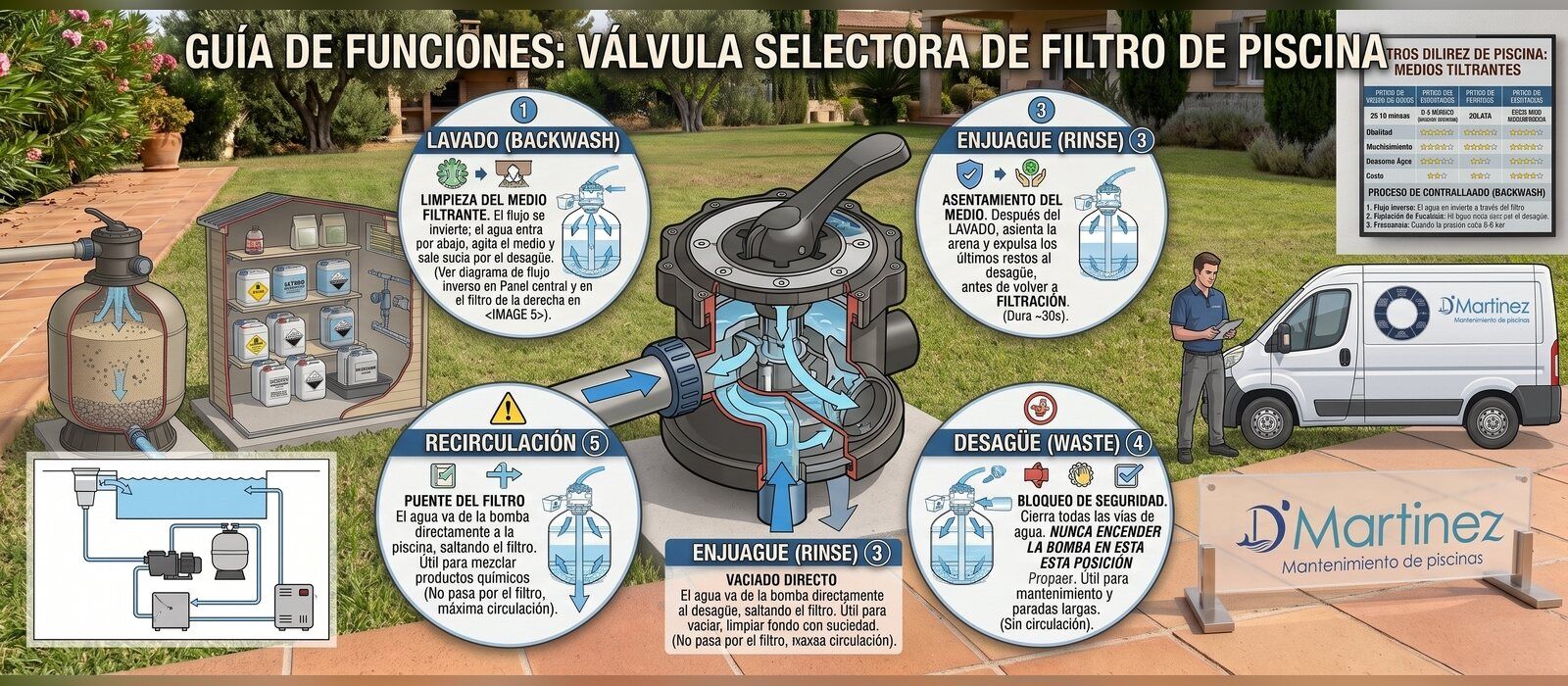
In small, single-family pools, it's usual for a single valve to combine the six operations of the filtration system: filter, backwash, rinse, recirculate, waste and closed. Knowing what each one is for avoids mistakes that, while they don't break anything, can send dirty water back into the pool or leave the filter working worse than it should.
Six positions, one valve
Tap a position or keep reading, the needle follows along.
1. Filter
The position the valve stays in the rest of the time, and the one that should be active the most hours every day. Water enters the filter from the top, passes through the filter media and returns clean to the pool.
2. Backwash
Reverses the direction of flow inside the filter, carrying out to the waste line the dirt that's built up during filtering. This is the operation that "cleans" the filter itself, not the pool.
3. Rinse
Done right after backwashing, never before. It's easy to confuse with backwashing because both send water to waste, but the direction the water flows in is different for each:
- During backwash, the water direction is reversed (from bottom to top) to strip the dirt out of the filter.
- During rinse, the water goes back to flowing in the normal direction (top to bottom, same as in filtering), but is still sent to waste instead of to the pool, to finish clearing out the dirt that backwashing loosened but didn't fully flush.
4. Recirculate
Moves the pool water without passing it through the filter. Used mainly to evenly distribute a chemical product you've just added, without the filter interfering in the process.
5. Waste
Sends the pool water straight to the drain, without passing through the filter. Used when the pool, or part of it, needs to be drained for some maintenance reason, something that, as we've seen in other guides, is the exception rather than the rule for most water problems.
6. Closed
Shuts off the water flow completely through the filtration circuit. Used for maintenance work on the filter itself or the pump, when you don't want water flow in either direction.
The order that really matters
Outside of daily filtering, the usual sequence when it's time to clean the filter is: backwash → rinse → filter. Skipping the rinse is the most common mistake, and it's the reason the water sometimes comes out cloudy right after you've "cleaned" the filter, in reality, that dirt never fully left.
If your pool uses a more advanced filtration system, like the ones we covered in our filter type comparison, the principle is the same even if the mechanism varies slightly between models.