
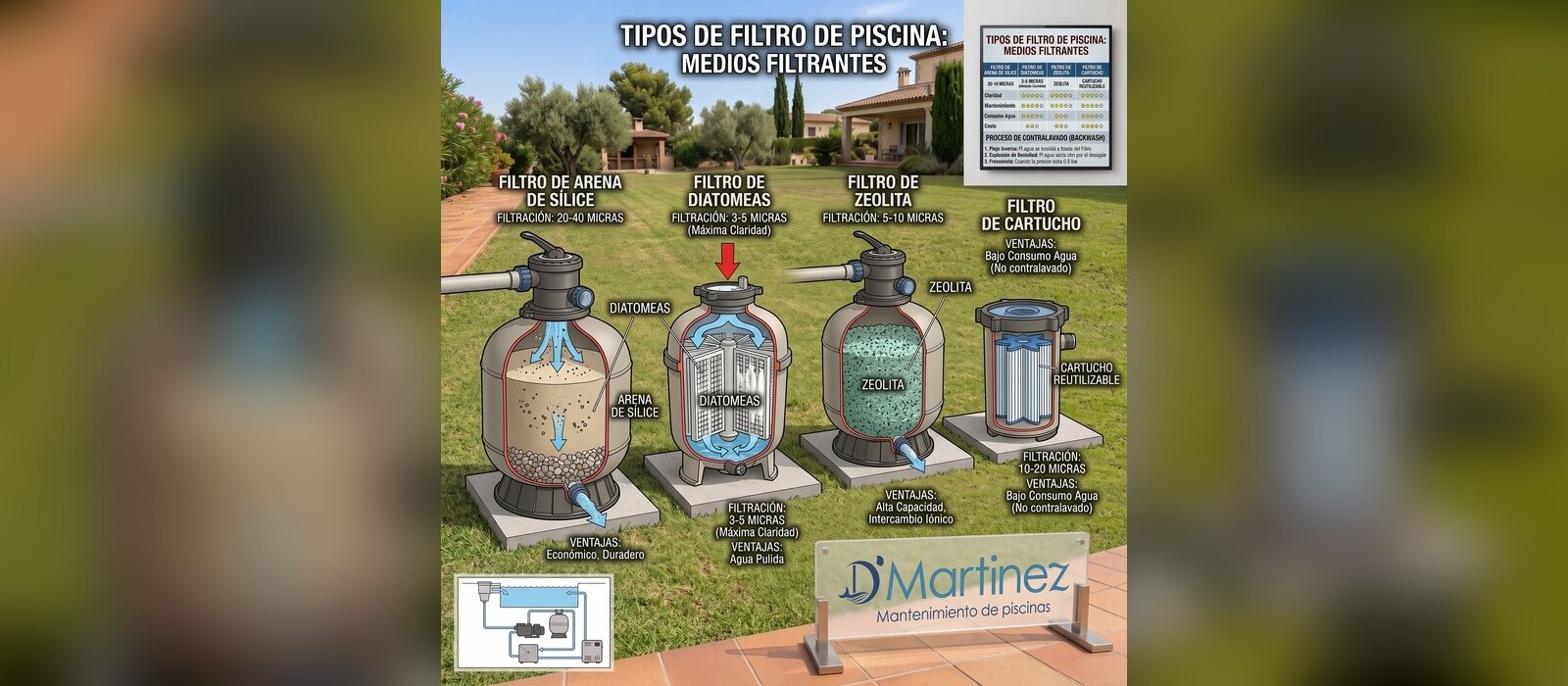
The filter is the part of the system that gets taken most for granted, until the water starts coming out cloudy for no obvious reason. Not every filter medium retains fine particles equally well, and choosing one over another changes both the water's clarity and how much chemical product you need to use.
Ability to trap fine particles
Comparing filtration power
From highest to lowest capacity for retaining fine particles:
A rough comparison of fine-particle retention capacity, not flow rate.
Silica sand, the industry standard
It's the most widespread filter medium, mainly for its price and how well understood its maintenance is. It retains medium-sized particles well, but not the finest ones, which is why it's the starting point of this comparison. With use, its grains lose their edges and compact, losing filtration capacity, we cover this in detail in our guide to filter sand replacement.
Recycled glass, a direct upgrade over sand
Made from crushed recycled glass, it retains slightly finer particles than silica sand and usually needs backwashing less often. It's a middle-ground option: an improvement over traditional sand, without reaching the jump in capacity of zeolite or cartridge filters.
Zeolite, more filtration without changing the filter
It's a mineral that, in many cases, can directly replace silica sand inside the same filter, with no need to change the equipment. It noticeably improves retention of fine particles compared with standard sand.
Cartridge filter, common in small pools and spas
Instead of a sand bed, it uses a replaceable cartridge made of paper, polyester or fibre through which the water passes, working in a similar way to a car's air filter. It has more filtration power than sand, but its lifespan is limited (around two seasons) and it needs to be removed for cleaning, usually once a week.
Diatomaceous earth filter, the highest filtration power
Diatomaceous earth is made of fossilised remains of microscopic algae, with a retention capacity far above any other filter medium on this list. As well as leaving the water especially clear, it reduces the amount of chemical product needed and takes up less space than an equivalent sand filter.
Its normal working pressure is also different: while a sand filter runs at between 0.5 and 1.0 kg/cm², a diatomaceous earth one works at around 1.5 kg/cm². When the pressure gauge starts rising above that reference value, it's the sign that the diatomaceous earth is saturated and needs replacing.
Which one suits which pool?
Silica sand and recycled glass remain the most sensible option for most private pools, for cost and simplicity of maintenance. Zeolite is an affordable upgrade when you already have a sand filter installed. Cartridge filters work well for small pools or spas. Diatomaceous earth is reserved for those after the maximum level of clarity who can handle a somewhat more demanding maintenance routine.
Frequently asked questions
Which type of filter has the most filtration power?
Diatomaceous earth, followed by cartridge, zeolite, recycled glass and silica sand, from highest to lowest capacity.
Can you use flocculant with a diatomaceous earth filter?
No, it's not recommended, it clogs the filter very quickly.
Does recycled glass filter better than silica sand?
Yes, somewhat better, although the difference isn't as big as with diatomaceous earth or cartridge filters.