
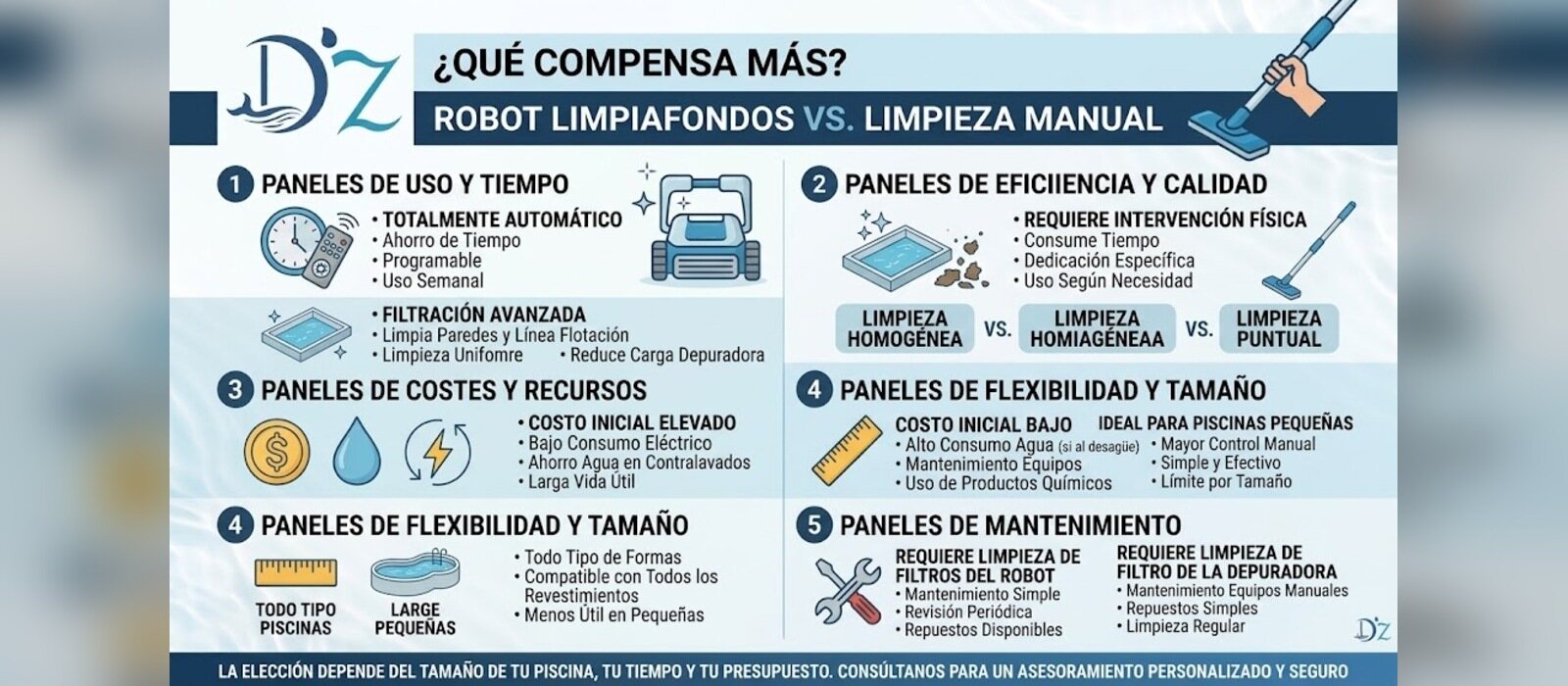
A robotic pool cleaner moves across the floor (and, depending on the model, the walls and waterline too) sucking up dirt on its own. The real question isn't whether it cleans well, most do, but whether your pool and your routine make the investment worthwhile.
What the robot does, and what it doesn't
The actual coverage, seen from above
Autonomous robot
Sweeps the whole floor in parallel passes, no skipped stretches, and it doesn't depend on your time.
Manual cleaning
Covers whatever you have time to reach, corners and steps are the first things left untouched.
When it is worth it
- Pools that get dirty regularly: leaves, pollen, ambient dust or heavy use mean vacuuming by hand keeps getting put off, exactly the problem a robotic cleaner solves best.
- Medium or large pools: the effort of manual cleaning grows quickly with size, and that's where the robot's convenience really shows.
- When you're after stability, not just cleanliness: less accumulated organic matter means the disinfectant works more predictably, with fewer spikes to correct.
When it usually isn't worth it
In small, simple pools with little dirt, where an occasional manual clean already leaves the water perfect. It also falls short when the expectation is total hands-off use, because every robot demands a minimum routine of its own: emptying and rinsing its filter after every cycle. If that routine doesn't fit you, the robot tends to end up in storage more than in the water.
What still needs a hand
Even with a good robot, there are situations where manual cleaning still makes sense: corners and hard-to-reach spots the robot doesn't cover well, compacted sediment after several weeks without use, early-stage algae that should be treated as soon as possible, and an occasional brush pass along the waterline, where body oils and sunscreen build up.
How to use a manual pool vacuum, step by step
If your pool has a manual vacuum (wand, pole and hose, connected to the pool's side inlet), these are the correct steps, in order:
- Stop the pump.
- Open the vacuum valve and close the skimmer. Adjust the drain valve.
- Start the pump (unless your setup has a shut-off plate on the wall inlet).
- Lower the vacuum head with the pole and hose into the water, letting the hose fill completely with water.
- Connect the hose end to the side inlet.
- Vacuum the entire pool.
- Turn off the pump.
- Reopen the skimmer valve and close the vacuum valve.
- Start the pump and watch the pressure gauge, backwash the filter if needed.
- Backwash the sand and rinse the pre-filter.
- Store the vacuum in a suitable place.
The best strategy isn't choosing one or the other
Combining a robot for everyday use with the occasional manual pass usually gives the best result, just as professional maintenance doesn't compete with either one, but handles the part neither the robot nor a manual pass can cover: the water's chemical balance.