
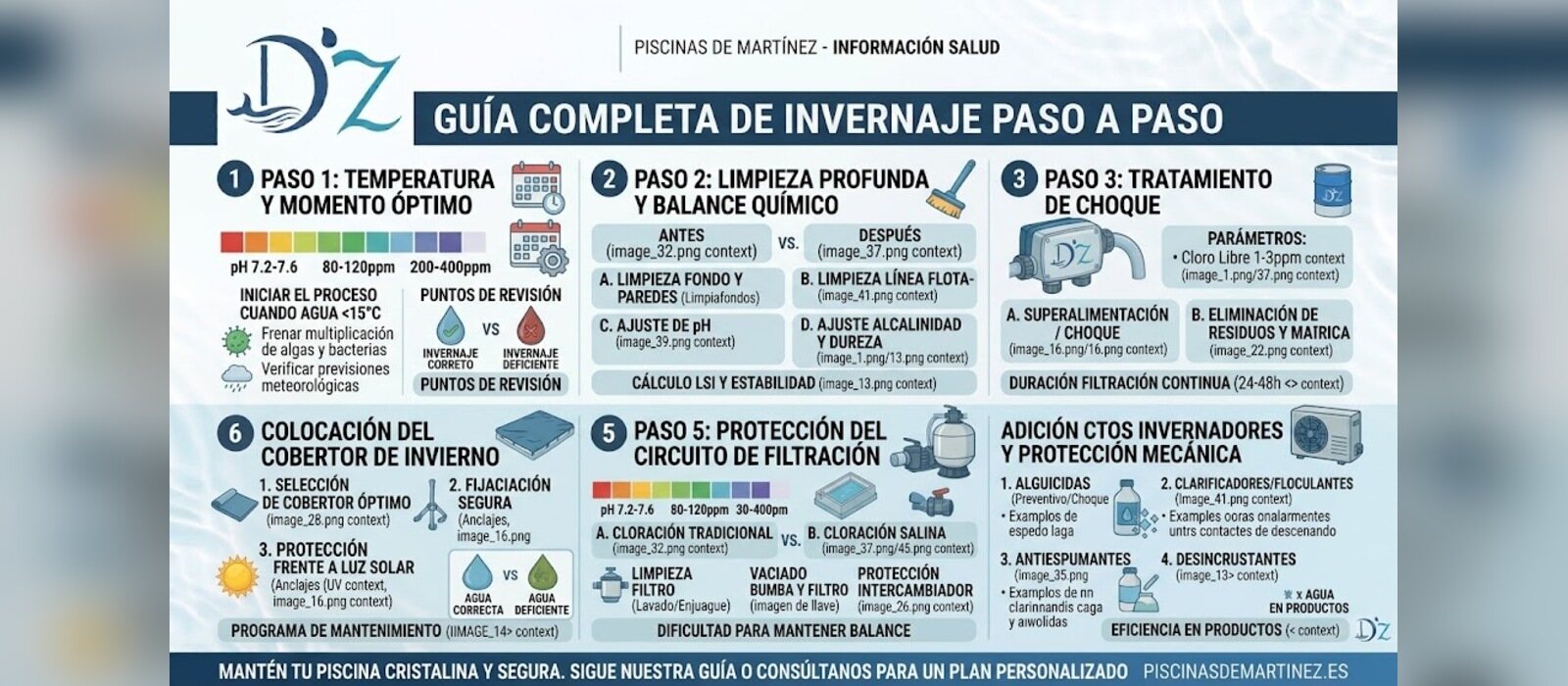
Many owners think that, if no one's going to swim, the pool can "wait" until spring untouched. It's exactly the opposite: the months with no use or supervision are precisely when algae, scale, frost damage or a filter that arrives at April in a mess are most likely to appear. (If you're looking for the opposite process, we also have the guide on how to open your pool in spring.)
Winterising isn’t abandoning
Why the pool needs winterizing, not just "leaving it"
- Frost can burst pipes and skimmers if stagnant water is left inside in areas with low temperatures.
- Untreated, uncirculated water is the perfect breeding ground for algae, which get much harder to remove the longer they've been settling in.
- Without filtration, dirt settles on the bottom and can end up staining or damaging the lining.
- An electrical panel left unprotected against winter humidity is an almost certain fault at the next start-up.
The steps, in order
Deep clean
Final shock
Balance pH
Lower the level
Drain and purge
Antifreeze
Cover with tarp
Protect the panel
| Step | Why |
|---|---|
| 1. Deep clean (floor, walls, waterline) | Start winter with as little organic matter as possible |
| 2. Final shock treatment | Leaves the water as "neutralized" as possible against algae and bacteria |
| 3. Balance pH and alkalinity before closing | Unbalanced water degrades linings for months |
| 4. Lower the water level below skimmers and return nozzles | Stops ice from bursting these fittings |
| 5. Drain and purge the pump, filter and pipework | Water left inside is what freezes and breaks parts |
| 6. Floats or antifreeze liquid in lines that can't be fully drained | Absorb the expansion of the ice |
| 7. Cover with a winter tarp, well secured | Less dirt, less sunlight (less favourable to algae) |
| 8. Protect the electrical panel from humidity | Prevents corrosion faults during winter |
Most common mistakes
- Leaving water inside the pump or filter: the number one cause of parts broken by ice in spring.
- Emptying the pool completely (unless strictly necessary for works): the weight of the surrounding ground can deform or lift an empty shell, especially on land with a high water table.
- Using just any tarp instead of a winter cover designed to bear weight (snow, branches) and properly secured.
- Not checking anything until the spring opening: a quick visit halfway through winter to confirm everything's still in place avoids big surprises.
What if my pool has a salt chlorinator?
Winterizing is practically the same, with one nuance: it's worth switching off and also protecting the chlorinator unit itself (not just the general electrical panel), and taking the chance to check the cell's condition before putting it away. That way it reaches the next season ready to run without surprises.
Would you rather we handle the closing for you?
We carry out the complete winterization with a checklist, and in spring the start-up with our season-opening service.