
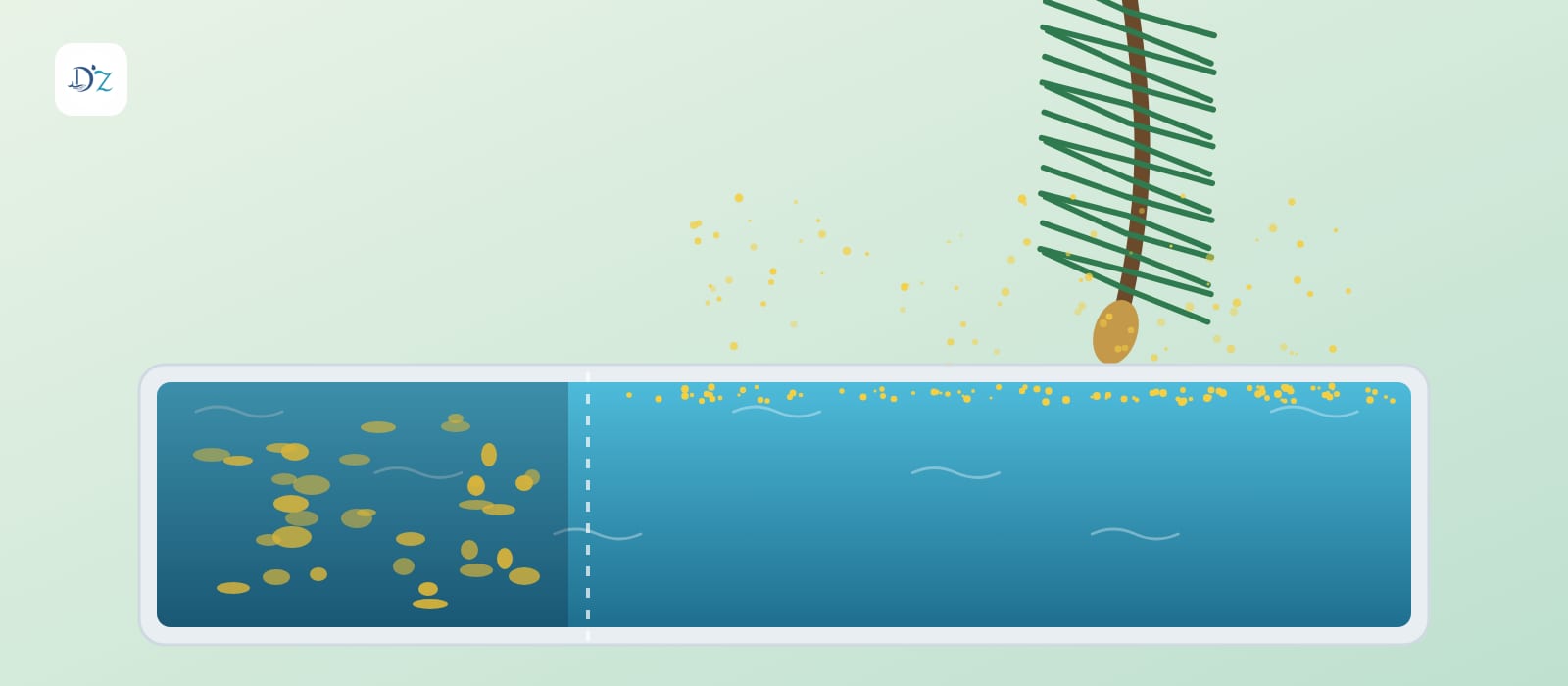
Pollen and mustard algae get mixed up because both look like yellow dust or fine sand. But pollen is dirt that arrives from the air and can be removed; mustard algae is an alga that grows in the pool itself and resists normal chlorine levels. Getting the diagnosis wrong means weeks of yellow dust that keeps coming back.
Where each one shows up
How to tell them apart
| Pollen | Mustard algae | |
|---|---|---|
| Where it appears | Floating on the surface and at the waterline; it collects in the skimmers. | Stuck to walls and floor, especially in corners and shaded areas. |
| When you brush it | There is nothing to brush on the walls. | It lifts off as a cloud of dust, but reappears within 1 or 2 days. |
| With chlorine in range | Nothing changes: it isn't a living thing growing in the water. | It's still there: maintenance chlorine doesn't kill it. |
| When | Spring and windy days. | Any time of year, more so with heat and poor circulation. |
The definitive test: vacuum and wait
Vacuum or brush the floor and walls thoroughly and wait 24 hours without touching anything. If the yellow dust reappears in the same places, especially in shaded areas, it's mustard algae: pollen or sand doesn't "grow back".
If it's pollen
- Skim the surface and empty the skimmer baskets often.
- Keep the filtration running and backwash when the filter pressure rises.
- Clean the waterline, where a yellow film sticks (see the guide on dirt lines at the edge).
- If the water loses its sparkle, a clarifier helps the filter trap the particles.
- At the height of pollen season, covering the pool when it's not in use saves a lot of work.
If it's mustard algae
- Brush thoroughly: walls, floor, steps and corners, to loosen it.
- Adjust the pH towards 7.2 so chlorine works as well as possible.
- Do a strong shock treatment at dusk: more intense than a normal shock. An algaecide specific to this alga helps.
- Filter continuously for 24 hours and vacuum whatever settles on the bottom.
- Disinfect everything that has been in the water: the robot, brushes, vacuum head, hoses, toys and even swimsuits. It's the number one reason it comes back.
- Backwash and keep brushing over the following days until it stops appearing.
Frequently asked questions
Is mustard algae dangerous?
It isn't toxic in itself, but it shows that disinfection isn't reaching every part of the pool. Until it's gone and chlorine is back in range, it's best not to swim.
Does pollen use up chlorine?
Yes, it's organic matter and uses up some chlorine. During heavy pollen season it's worth testing more often, although a shock is rarely needed for pollen alone.
I shocked the pool and it came back a week later. Why?
Almost always because an accessory (the robot, a brush, a toy) or an unbrushed corner has reseeded it. Repeat the treatment and disinfect everything that has been in the water.