
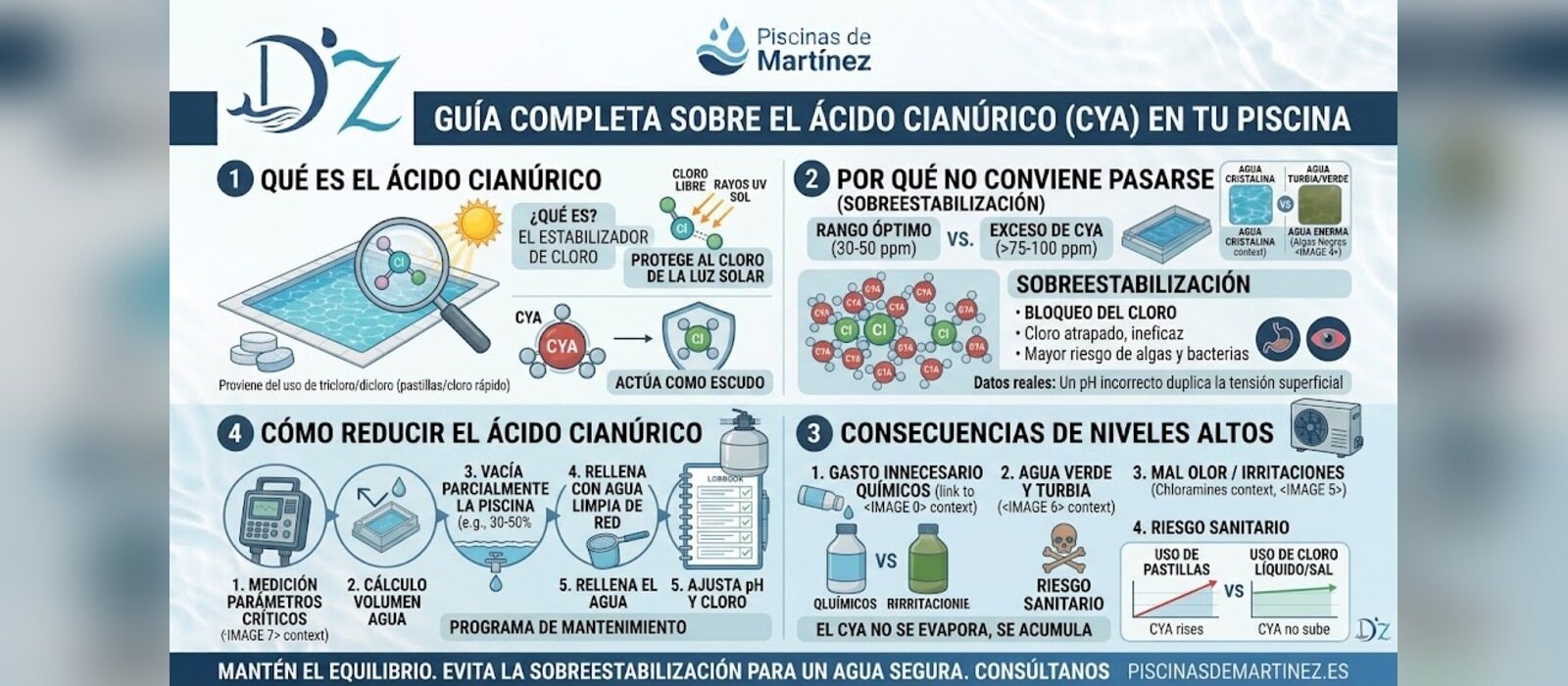
Cyanuric acid (CYA), also called stabilizer or conditioner, is the product that stops the sun from destroying your pool's chlorine within a few hours. Without it, an outdoor pool can lose up to 90% of its free chlorine after just a few hours of direct sun exposure. With it, chlorine lasts much longer, but only up to a point.
A shield for chlorine, within limits
Cyanuric acid
Below this range, chlorine degrades very quickly in the sun. Above it, it "locks up" chlorine and makes it less effective even though the reading may look correct. The legal limit is 75 ppm, 30-50 ppm is the range where it works best in practice.
Why outdoor pools need stabilizer
The sun's ultraviolet radiation breaks down chlorine quickly. Cyanuric acid acts as a kind of molecular "shield" that greatly slows that breakdown, allowing chlorine to last long enough between visits. That's why it's common in any outdoor pool, whatever chlorination system it uses, including salt chlorinators, since the chlorine the cell generates is exactly as vulnerable to the sun as chlorine added by hand.
The problem: over-stabilization
Here's the lesser-known part. The more cyanuric acid there is in the water, the slower and less effective the available chlorine becomes, it doesn't just protect chlorine from the sun, it also reduces its ability to act against bacteria and algae. With high stabilizer levels, your chlorine can read "in range" and still not be disinfecting enough. It's one of the less obvious but very real causes of a pool that keeps getting green water problems even though the chlorine "looks correct".
Excess stabilizer also affects the water's overall balance, it can lower the Langelier Saturation Index, making the water more aggressive towards surfaces and equipment, not just less effective as a disinfectant.
How it builds up without anyone noticing
Here's the trap: many of the most common chlorine products, dichlor and trichlor, widely used in tablets, have cyanuric acid built into their own formula. Every time they're used, you're not just adding chlorine, you're also adding stabilizer cumulatively. Over time, especially in pools that only use stabilized chlorine tablets, CYA levels can climb far higher than anyone intended.
What about indoor pools?
They don't need it. Cyanuric acid only makes sense as protection against solar radiation, in an indoor pool with no direct sun exposure, it serves no real purpose and only adds one more parameter to monitor without any benefit in return.
Frequently asked questions
Do pools with salt chlorinators also need cyanuric acid?
Yes, if they're outdoors. The chlorine the cell generates is just as vulnerable to the sun as chlorine from any other system.
How do you reduce cyanuric acid if there's already too much?
There's no product that removes it directly. It goes down over time, very slowly, the real way to lower it quickly is to dilute the water, draining part of the pool and refilling with fresh water.
Do indoor pools need stabilizer?
No. It protects chlorine from solar radiation; without direct sun exposure, it serves no purpose.