
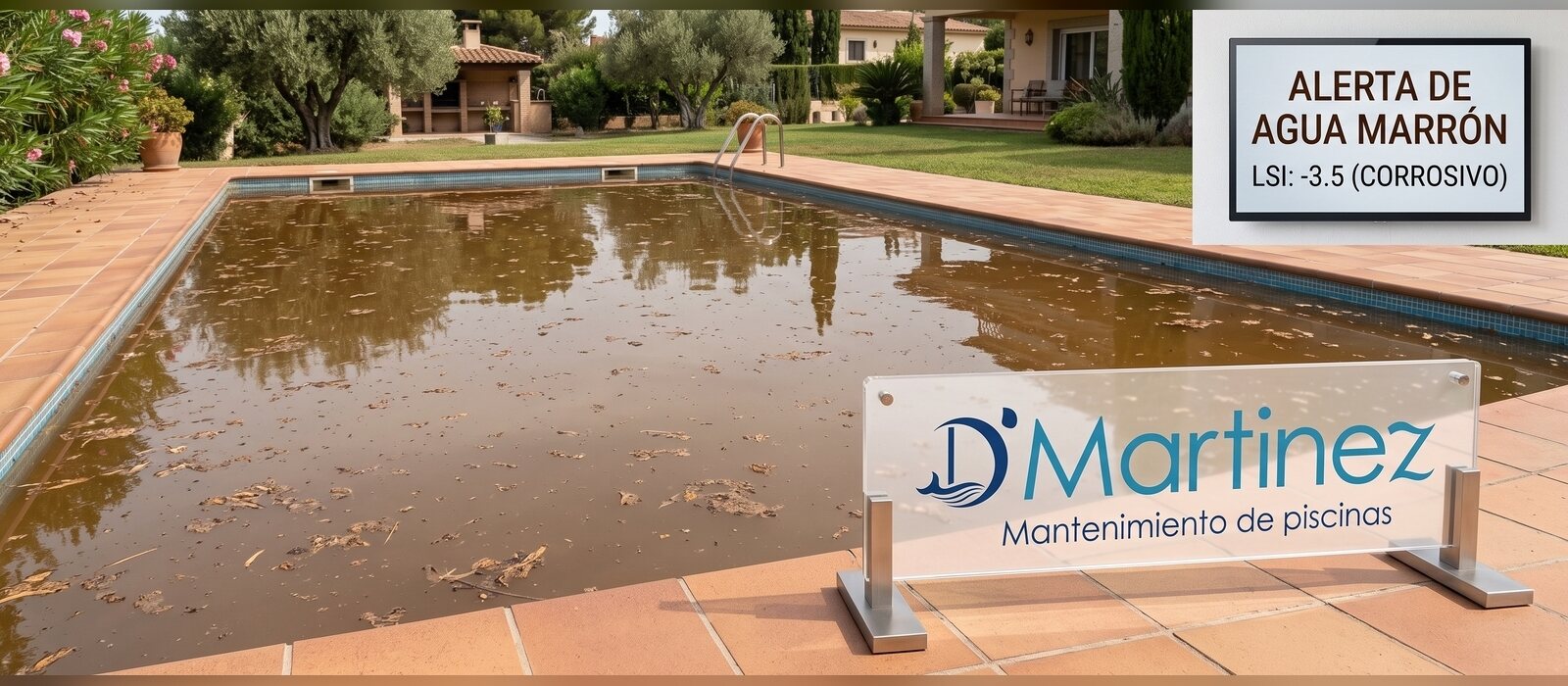
When water loses its clarity, the first suspicion is usually algae, but cloudy (milky, whitish) water and brown or orange (iron-stained) water have completely different origins, and neither is solved with shock chlorination.
Why the water goes cloudy
Filtration or calcium hardness
- Saturated filter or spent sand
- Or excess calcium salts in suspension
- Improves with backwashing and more filter hours
Iron-based origin (metals)
- Iron or manganese dissolved in the water
- Chlorine makes it visible, it doesn't cause it
- Needs a metal sequestrant, not more chlorine
Cloudy or milky water
It mainly has two possible causes:
- Insufficient filtration: the filter isn't retaining the fine particles in suspension, either because it needs backwashing, because the sand is spent (check our guide on filter sand replacement), or because the daily filtration time is too short for the pool's volume.
- Excess calcium salts in suspension: when calcium hardness is very high, calcium can precipitate as fine particles that cloud the water without ever settling out as scale. You can check this parameter in our calcium hardness guide.
How to tell them apart: if the cloudy water clearly improves after a thorough backwash and a few more hours of filtration, it was a filtration problem. If it doesn't improve, it's worth checking calcium hardness before continuing to focus on the filter.
Brown, orange or iron-stained water
This colour almost always comes from metals dissolved in the fill water, mainly iron, and to a lesser extent manganese. While the metal is dissolved, it's invisible; the problem appears when chlorine oxidises it: dissolved iron turns into iron oxide, which is insoluble, and precipitates out giving that characteristic brown or orange tone. With manganese, the tone is usually darker, almost blackish.
How iron-stained water is treated
Dissolved iron and manganese are not removed with chlorine, you need one of these two approaches:
- Metal sequestrant: a product that "traps" the dissolved metal before it can oxidise and precipitate, preventing the colour from appearing. This is the preventive route, applied regularly if the fill water is known to contain metals.
- Flocculation: if the metal has already precipitated and the water is brown, a flocculant groups those fine particles into larger ones that are easy to catch in the filter. It requires extended filtration afterwards to remove everything that's been grouped together.
If your pool's fill water comes from a well or your own tank (not the public supply), and you notice this problem recurring, it's worth having that source water analysed, it's more effective to prevent iron from getting in than to treat it every time it appears.
Frequently asked questions
Is cloudy water the same as green water?
No. Green water is always algae. Cloudy water is usually due to insufficient filtration or excess calcium salts, different causes, with different treatments.
Why does the water turn brown or orange?
Almost always because of dissolved iron in the fill water, which oxidises on contact with chlorine and precipitates out.
Can iron-stained water be treated with ordinary chlorine?
Chlorine doesn't remove iron, it only makes it visible. You need a metal sequestrant or flocculation, followed by thorough filtration.