
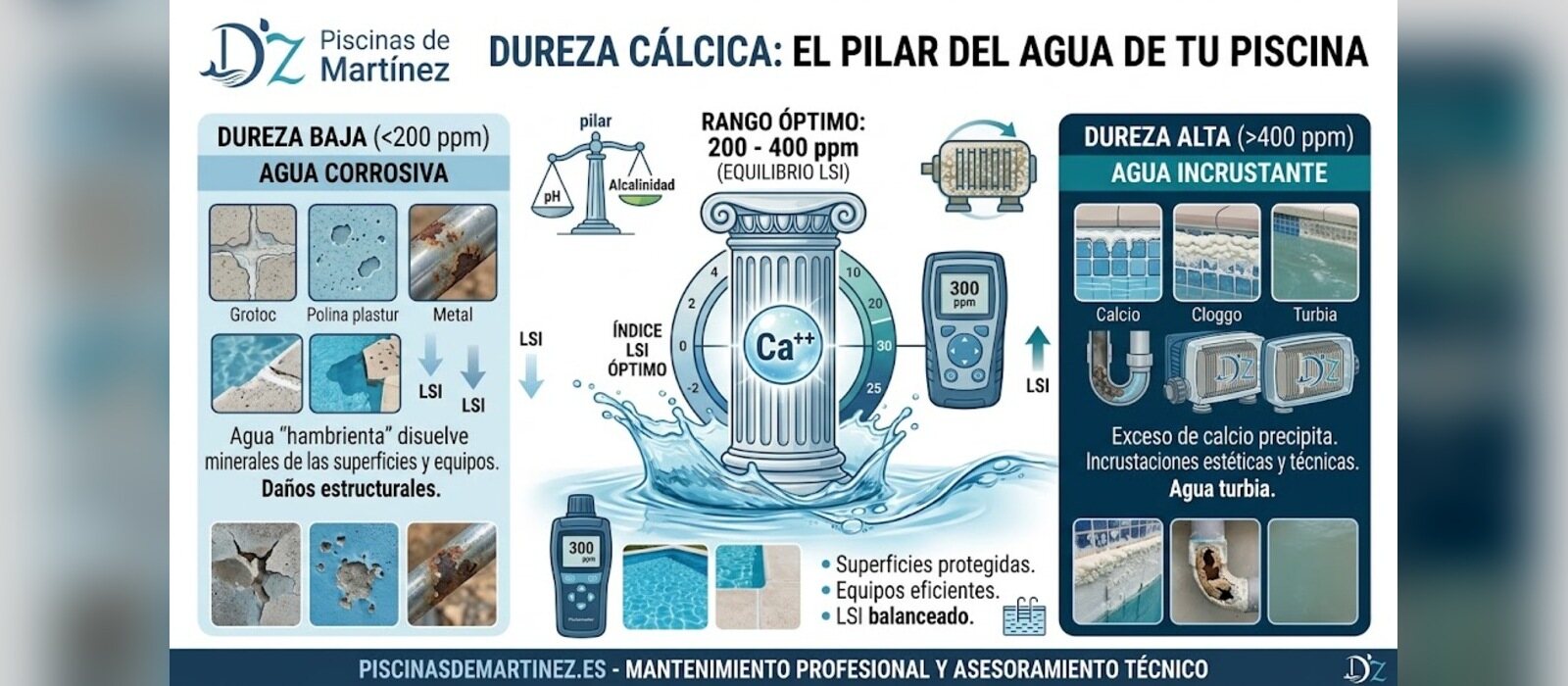
If you've come here from our Langelier Index calculator, you already know three of the four parameters that decide whether your pool water is corrosive or scale-forming: pH, alkalinity and, for stabilized water, cyanuric acid. Calcium hardness is the piece that usually stays off the radar, and it's just as important as the others.
Neither “hungry” nor scaling
Calcium hardness
Below the range, the water becomes corrosive and attacks grout and metal parts. Above it, it forms scale and deposits.
What it actually is
Calcium hardness measures the amount of calcium dissolved in the water, expressed in ppm (parts per million, you can review what that unit means in our guide to PPM). It's not a parameter you "treat" every week like chlorine, but being out of balance in either direction has real consequences for the facility.
When it's too low: "hungry" water
Water with too little calcium tends to behave as if it's hungry for it, and draws it from any surface that contains it: tiling, concrete, grout, even certain equipment. It's the same "aggressive" tendency that a low Langelier Index can indicate, and over time it wears the facility down progressively, almost imperceptibly month by month.
When it's too high: scale-forming water
The opposite excess also has consequences: walls that feel rough to the touch, whitish limescale stains (we cover this in more detail in our guide to pool stains), and a gradual loss of filtration system efficiency as scale builds up in the pipes and filter.
How it's corrected
Calcium chloride is used to raise calcium hardness, added gradually just like other correctors. To lower it, there's no product that reduces it directly, in practice, diluting the water (draining part of it and refilling with fresh water) is usually the only real option, the same principle we already saw for excess cyanuric acid.
With this, the picture is complete: pH, alkalinity, calcium hardness and, for stabilized water, cyanuric acid, the four parameters that, together, determine whether your pool is truly balanced. You can check it yourself by entering your figures into the Langelier Index calculator.