
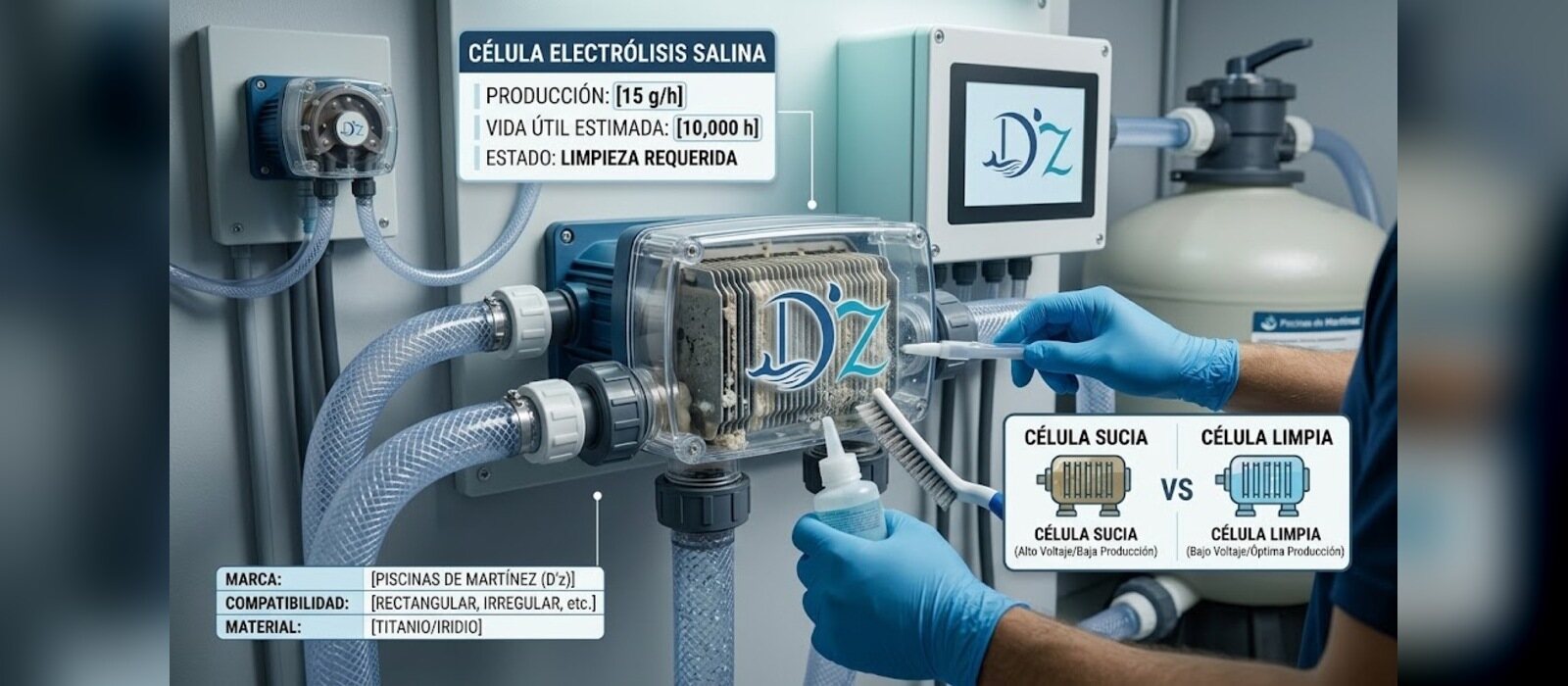
If you have a salt chlorinator, you probably already know that the salt itself isn't "used up" (except for what's lost through splashing, rain or partial drainings). What does have a limited lifespan is the electrolytic cell, the heart of the system.
100% production
- Chlorine stays within its range without effort
- Clean plates, no white layer stuck on
- No error warnings or low amperage
Insufficient production
- The chlorinator runs at 100% and chlorine stays low
- Cloudy water or algae more easily
- White layer that doesn't come off when cleaned
What exactly does the cell do?
The cell (also called an electrode or plates) is where electrolysis happens: as the salt water passes over its titanium plates with a small voltage applied, the dissolved salt (sodium chloride) is converted into active chlorine, which disinfects the pool, and turns back into salt shortly afterwards. That's why a salt chlorinator continuously "generates" chlorine without you having to add it by hand.
Electrolysis, step by step
Salt water flows between the plates with a small voltage applied, there, chloride (Cl⁻) turns into active chlorine (the bubbles), which disinfects the pool and recombines as salt shortly afterwards.
How long does a cell last?
As a rough guide, a well cared-for cell usually lasts between 3 and 5 seasons, or between 10,000 and 15,000 hours of effective operation (manufacturers usually state this in hours in the unit's manual). The actual lifespan depends on several factors:
- Water quality: very high hardness (calcium) speeds up limescale build-up on the plates.
- Production hours: heavily used pools or ones with poorly adjusted salt levels put more strain on the cell.
- Maintenance: a cell that is cleaned periodically lasts noticeably longer than one that's never checked.
- Salt level: operating outside the recommended range (usually 3,000-4,500 ppm) wears out the cell ahead of time.
How to look after it so it lasts longer
With use, limescale gradually builds up on the cell's plates (especially if the water is hard), forming a whitish layer that reduces its effectiveness. Most modern chlorinators include a polarity-reversal system that delays this effect, but doesn't eliminate it entirely. Periodic cleaning with a specific descaling product (or a diluted acid solution, with the necessary precautions) restores much of the lost performance.
Signs the cell is worn out
| Sign | What it usually indicates |
|---|---|
| The chlorinator runs at 100% and chlorine stays low | The plates are no longer producing what they should |
| Water becomes cloudy or algae appears more easily | Insufficient chlorine production |
| Visible white layer on the plates that doesn't come off when cleaned | Permanent wear or scale build-up on the coating |
| The unit shows a cell error or low amperage | Direct warning from the chlorinator itself |
| Several seasons have passed without replacing it | It's reasonable to check it even without clear symptoms |
Replace the cell or the whole unit?
In the vast majority of cases, only the cell needs replacing: it's a part that can be swapped independently on practically every salt chlorinator on the market. Only if the control unit itself has a separate fault (electronics, display, transformer) would it make sense to consider replacing the whole thing.
Not sure if your cell still has life left in it?
We'll check it on the next visit and tell you clearly whether it's worth cleaning or already time to replace it.