
It's the question we get asked most when someone is thinking about switching systems: traditional chlorine or a salt chlorinator? There's no single right answer for everyone, it depends on your pool, how much you use it, and what your household prioritizes. Here's the honest comparison, without just listing the advantages of one of the two.
How each system works
Traditional chlorine (in tablets, granules or liquid) is added manually to the water to maintain a free chlorine level that disinfects it. You decide how much and when, based on what your test readings show.
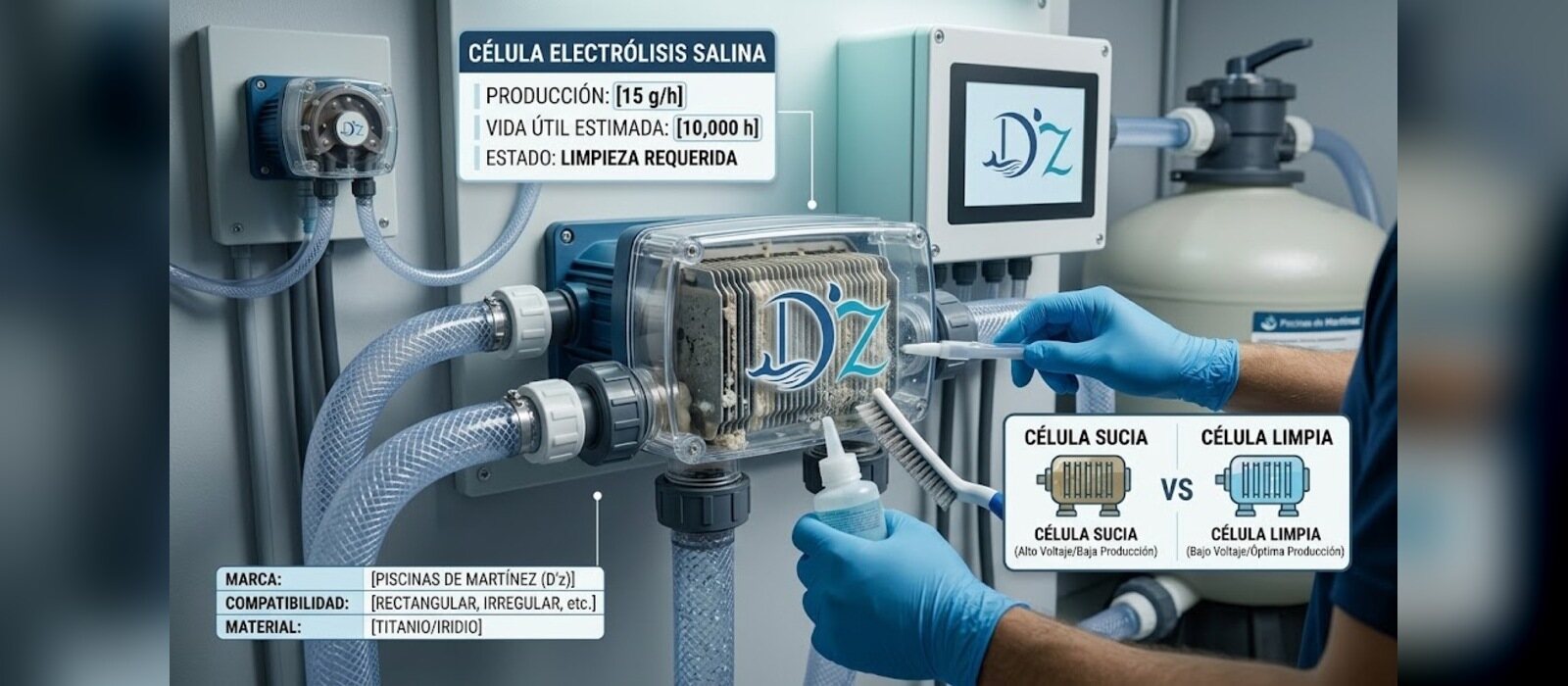
Salt chlorination doesn't remove chlorine: it generates it automatically. Ordinary salt is added to the water, and a unit installed in the filtration circuit, the salt chlorinator, turns it into chlorine through electrolysis, in a continuous process while the water filters. We explain this in more detail in our salt chlorination guide.
Traditional chlorine
Salt chlorination
On the left, chlorine only arrives when you add it. On the right, the system generates chlorine continuously while the water filters.
Direct comparison
| Traditional chlorine | Salt chlorination | |
|---|---|---|
| Dosing | Manual, you need to remember | Automatic and constant |
| Feel and smell of the water | Characteristic chlorine smell | Softer water, barely any smell |
| Handling of products | Direct contact with tablets or concentrated liquid | Minimal, only when adding salt |
| Initial cost | Low, no equipment required | Requires installing a unit |
| Ongoing maintenance cost | Recurring chlorine purchases | Just salt and periodic cell checks |
| Equipment maintenance | None specific | Annual cleaning/inspection of the cell, and replacement every few years |
| Stability of the chlorine level | Depends on how consistently you dose | More stable, since it's generated continuously |
This is an indicative comparison. The actual cost of each option depends on your pool's volume, the equipment chosen and how you use it, we'll give you the details with no obligation during the assessment visit.
When does traditional chlorine pay off more?
- Pools used only occasionally, where the initial investment in equipment isn't worth it.
- When you'd rather not depend on an additional electronic unit that also needs servicing.
- A tight initial budget: traditional chlorine requires no installation outlay.
When does salt chlorination pay off more?
- Families with small children or sensitive skin: the water is noticeably softer.
- Pools used frequently throughout the whole season, where the convenience of automatic dosing is felt more.
- Anyone who wants to reduce direct handling of concentrated chemical products.
- Pools where instability in the chlorine level has already been detected due to irregular manual dosing.
Can a chlorine pool be converted to salt?
Yes, in the vast majority of cases, with no building work or need to drain the pool: it's enough to install the salt chlorinator in the existing filtration circuit. It's compatible with mosaic-tile, liner or fiberglass pools, as long as the unit is properly sized for the water volume.