
The short answer is no. Concrete and gunite are naturally porous materials, they're made from a mix of aggregate, cement and water that, once it cures, leaves behind a network of microscopic pores and capillaries the water can slowly seep through. That's why no concrete-built pool, however well-engineered its structure, is considered finished until it has a waterproof finish on top of it.
What actually makes it watertight
Why concrete needs a separate finish
Poured concrete (cast in formwork) and gunite (shotcrete) do the same job: giving the shell its shape and structural strength, holding up against the water pushing from inside and the surrounding ground pushing from outside. That's a purely structural task, not a watertightness one. Its natural porosity, combined with the near-inevitable appearance of hairline cracks over time, from curing itself, temperature swings, or small ground movements, means water will always find a way through if nothing stops it.
What each waterproof finish actually does
Every finish applied over the structure has the same mission, creating a continuous barrier between the water and the concrete, but each does it differently:
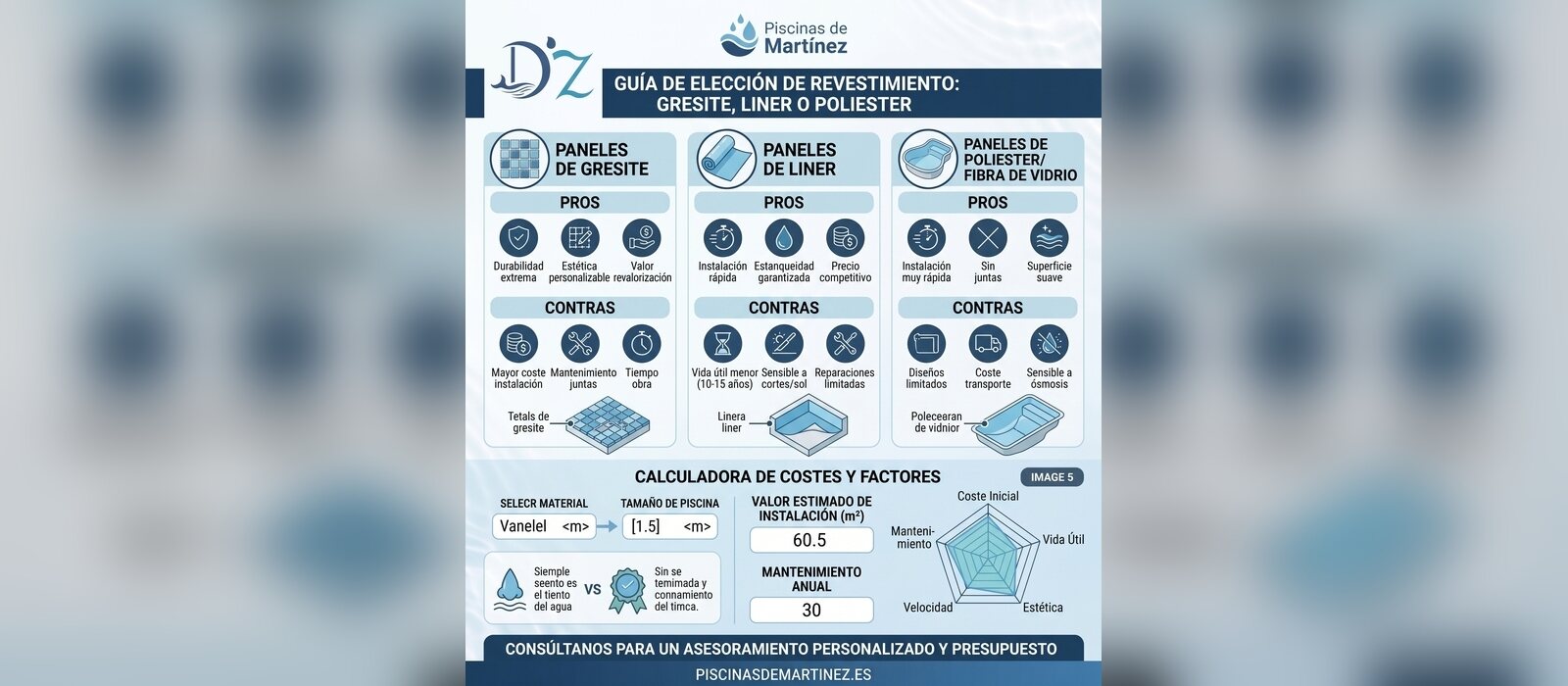
- Tile / mosaic (gresite). Small pieces that are practically waterproof on their own, bonded with mortar onto the structure. The real watertightness depends on the grout lines between tiles staying in good shape, since that's where water can get through if they deteriorate.
- Liner (PVC membrane). A continuous membrane, in one piece or welded, shaped to fit the pool's contours. With no exposed joints in contact with the water, it offers a very uniform barrier, though it's more sensitive to abrasion, sharp objects, or UV wear over the years.
- Polyester resin. Applied in liquid layers that cure into a continuous, highly resistant surface, similar in concept to a liner, but bonded directly to the structure with no loose membrane involved.
- Microcement and pool-specific paints. Thinner finishes with good aesthetic results, but they require careful application and closer maintenance to keep their watertightness over the long run.
Each option strikes its own balance between looks, durability, maintenance and cost. If you're weighing which one fits your pool best, we have a full guide comparing tile, liner or polyester resin.
Why leaks can still appear even so
Even with a finish in perfect condition, the concrete structure itself can develop hairline cracks over time, and those cracks can eventually work their way through the finish above them or open up right at a joint or a fitting (a skimmer, return jets, main drain). That's why a pool can start losing water slowly and almost imperceptibly with no visible fault anywhere. If you notice the water level dropping more than usual, our guide on how to detect pool water leaks is worth a read, starting with the classic bucket test to rule out plain evaporation first.
Frequently asked questions
So is the concrete in my pool useless?
Not at all, it's the structure that gives the shell its shape and strength. What it doesn't do on its own is hold the water without leaks, that's the job of the waterproof finish on top of it.
Can a tiled pool still have leaks?
Yes. The tiles themselves are practically waterproof, but they're bonded onto a layer of mortar that can crack, and the grout lines between tiles are weak points where water can get through if they aren't kept in good condition.
Which finish waterproofs a community pool best?
There's no single best option for every case, it depends on foot traffic, budget and how much maintenance you're willing to put in. Liner and polyester resin tend to offer a more consistent, continuous watertight seal; tile offers better looks and stands up well to heavy use, as long as its grout lines are properly watched.