
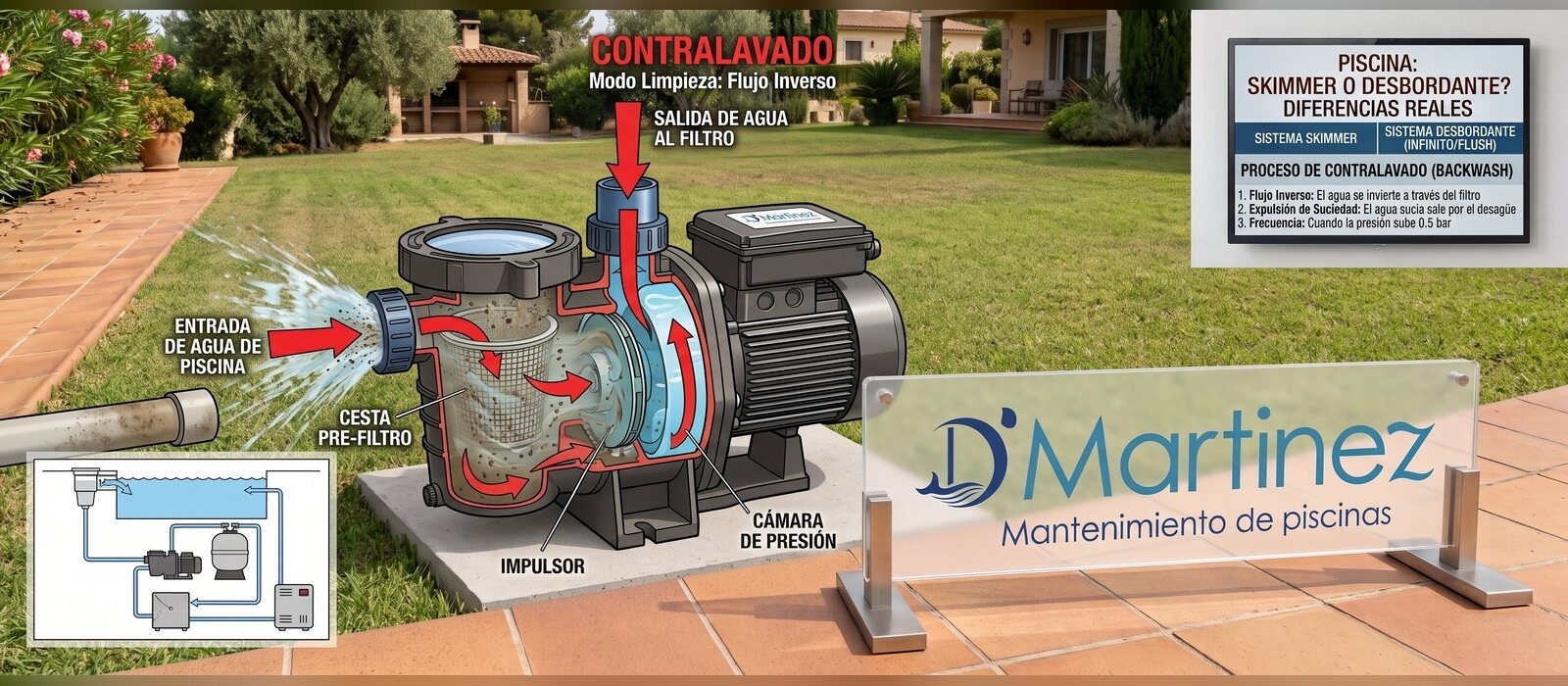
Backwashing reverses the direction of water flow inside the sand filter to flush out all the dirt it has trapped, sending it to the drain. It's essential maintenance, but only when it's due, not before.
Backwashing, in order
How to know when it's needed
The reliable indicator is the filter's pressure gauge, not the calendar. Note the pressure right after a backwash (your "reference pressure"), and when the gauge reads 0.4 to 0.5 bar above that value, it's time. In a normally used pool, this usually works out to every 2-3 weeks in high season, but it varies a lot depending on use and how dirty the surroundings are.
The steps, in order
Stop the pump
Backwash 2-3 min
Stop, switch to Rinse
30-60 sec on Rinse
Back to Filter
- Stop the pump. Never move the selector valve with the pump running, you could break the internal seal.
- Switch the valve to "Backwash". Turn on the pump and let the water run until the sight glass (if your filter has one) shows clear water, usually 2-3 minutes, never more than 4.
- Stop the pump again and switch the valve to "Rinse", if your filter has that position.
- Run the pump for 30-60 seconds in that position, this re-compacts the sand that shifted during backwashing.
- Stop the pump, switch back to "Filter" and turn it on again. Check that the gauge has dropped back to (or close to) your reference pressure.
Normal filtration
Backwash
Why backwashing too often is a mistake
It sounds counterintuitive, but a sand bed with a bit of dirt already trapped filters better than one that's completely clean, that trapped dirt helps retain even finer particles, like a second natural mesh. Backwashing without need just sends clean water down the drain for no reason, and leaves the filter working below its normal performance for the first few days, right when the water is most vulnerable.
How to know how much water you're losing
Every full backwash cycle (backwash + rinse) uses real pool water, so it's worth keeping in mind if you're watching the level, especially if you've just checked for a possible leak and want to rule out the drop being caused only by recent backwashes, rather than an actual leak.