
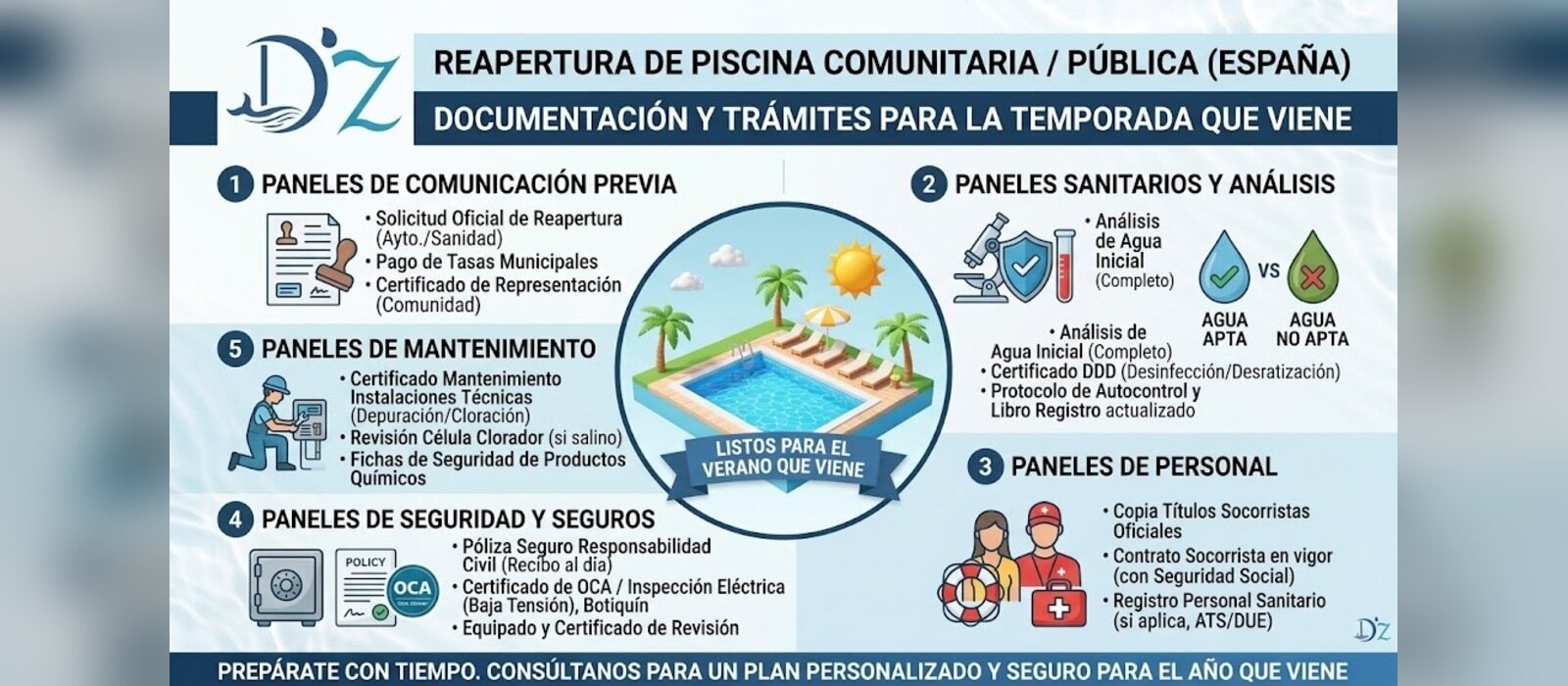
To make any municipal or regional inspection easier, the pool's owner must have all of this documentation on-site from the very first day of opening, it's not enough to gather it "when the inspection comes."
Everything ready before the first swim
- Contract for the lifeguard and their substitute
- Contract for the doctor or nurse (A.T.S./D.U.E.), if applicable
- Contact details of the maintenance company
- Tax ID (N.I.F.) of the residential community
- President's details
- Number of dwellings
- Safety data sheets for the products
- Initial analysis of the pool basin
- Sanitary Control Logbook
Documentation about the people involved
- Contract for the lifeguard and/or their substitute, together with documentation proving their qualification.
- Contract for the doctor and/or nurse (A.T.S./D.U.E.), if the facility requires it based on its type or capacity.
- Full name of the person or maintenance company in charge, with a contact phone number and address.
- Commitment to phone availability: if the community doesn't have a landline on-site, there must be a written commitment to always have a mobile phone available at the facility.
Documentation about the community
- Tax ID (N.I.F.) of the residential community (or of the company, if applicable), updated if there has been any change, or a new opening.
- Name, ID number, address and phone number of the community's president.
- Number of dwellings that make up the community.
Documentation about the water and chemical products
- List of chemical products to be used during the season, together with their safety data sheets.
- Initial analysis of the pool basin's water before opening, and if the water was left dormant or underwent a recovery process, also the products used in that process.
- Basic information for each pool basin: type of filter installed, pump flow rate, theoretical and actual recirculation time, and filtration speed.
- Dosing system for each basin's water: whether it's automatic or semi-automatic.
What if the pool is for public use?
Every public-use pool (type 1: public pools, leisure pools, water parks and spas; type 2: hotels, tourist accommodation, campsites or therapeutic pools in healthcare centres) needs a specific self-monitoring protocol, under Article 11.5 of RD 742/2013. In the Community of Madrid, residential communities of more than 30 homes need one too (Decreto 99/2024, art. 18). It must be kept at the pool, available to maintenance staff and the competent authority, and updated as often as needed.
Why it pays to have everything ready from day one
It's not just about avoiding a penalty if there's an inspection, having this documentation organized from the start of the season also speeds up any dealings with the community, with a new maintenance company, or with the board itself when someone asks "how are we doing with the pool?"