
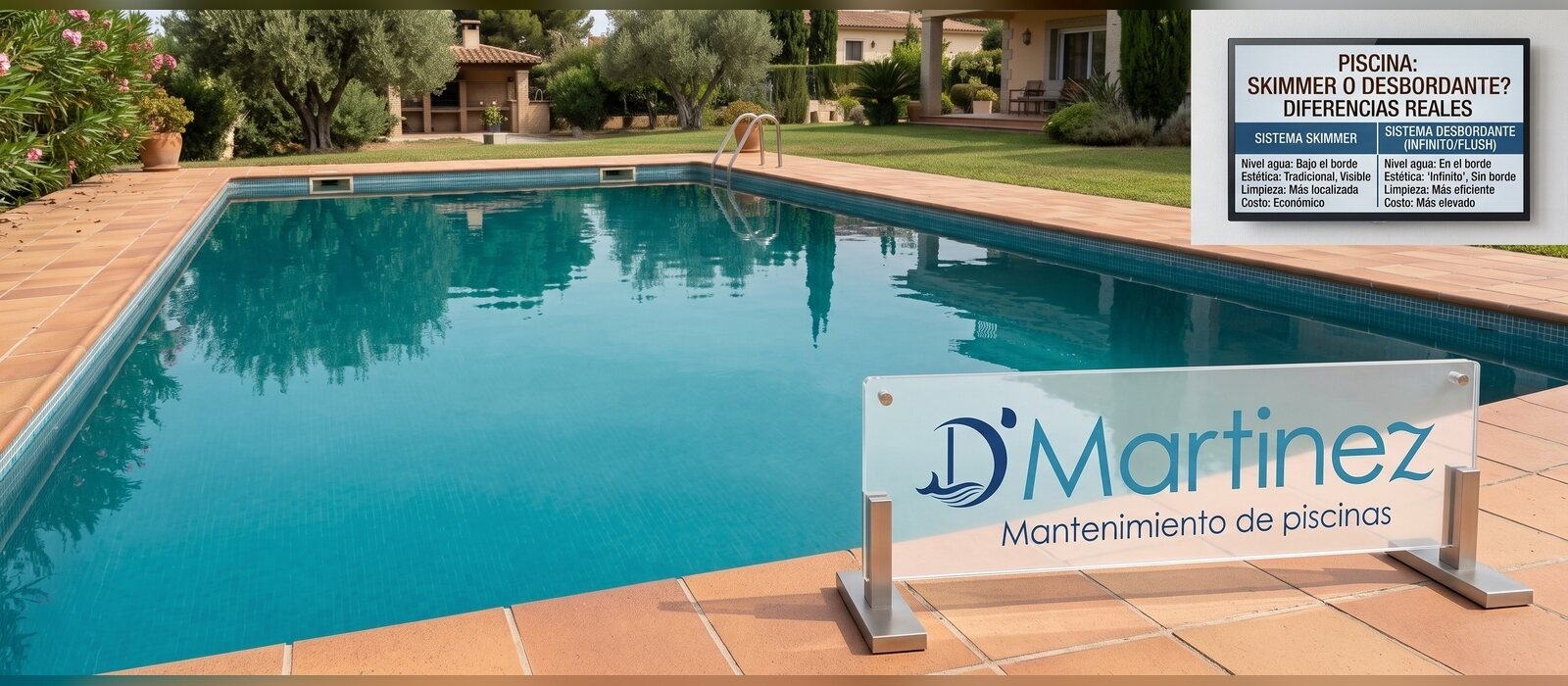
At first glance, the difference is visual: in one, the water sits a few centimetres below the edge; in the other, it reaches right up to the top and spills over. But behind that visual difference lie two completely different hydraulic systems.
The most common system
- Cheaper to install and maintain
- No balance tank needed
- Lower water and electricity use
More stylish, more complex
- Installation cost 15% to 30% higher
- Filtration oversized by 40-50%
- The channel and the balance tank need their own cleaning
How each one works, on the inside
In a skimmer pool, the surface water is drawn in through side inlets (the skimmers) located just below the edge, and from there it goes straight to the filtration system. In an overflow pool, water spills over one or more sides into a perimeter channel, drops into a balance tank (a reservoir that stores between 5% and 10% of the pool's total volume), and from there the pump sends it to the treatment system.
Skimmer pool
Overflow pool
What this means for day-to-day maintenance
In a skimmer pool, maintenance focuses on the skimmer and pre-filter baskets. In an overflow pool, on top of that you also need to check that the perimeter channel doesn't get clogged with plant debris or dirt, plus periodic cleaning of the balance tank, it isn't much more work, but it is different.